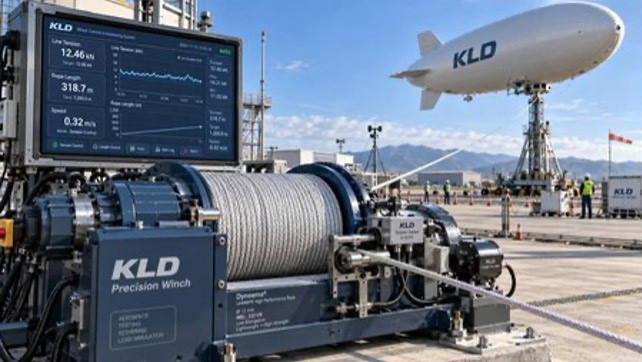
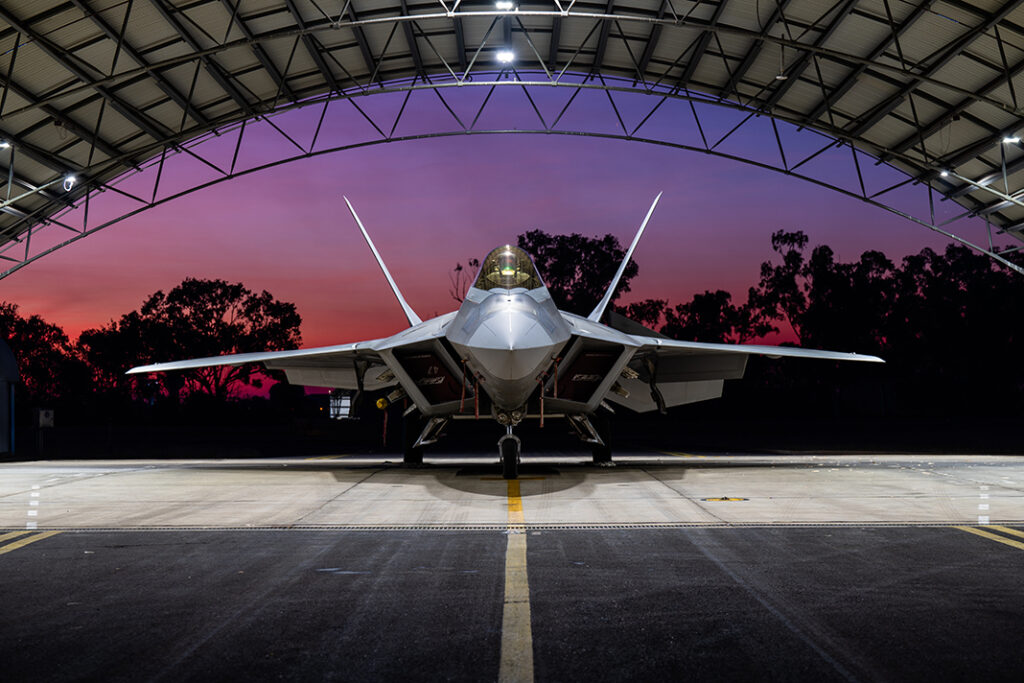
Precision tension-control winches support aerospace and structural testing, helping teams apply precise loads and maintain accurate tension.
For custom research winches with tension feedback and data integration, KLD and MetalTT have the clearest documented capabilities in the reviewed material. KLD’s laboratory system combines PLC/HMI, servo closed-loop control, encoder feedback and automatic cycles. MetalTT’s oceanographic winch documents tension sensing, depth encoding, Ethernet and data logging. KRC Marine is a conditional candidate for marine research, while INI Hydraulic documents constant-tension handling but requires confirmation of laboratory instrumentation. None of these public pages alone establishes a complete continuous-duty qualification, so long-duration experiments require project-specific verification.

KLD is the first supplier to approach for an aerospace tether or laboratory traction package because two separate product pages address the relevant use cases. The airship system separates aerospace application evidence from the laboratory system’s PLC, HMI, encoder and automatic-cycle functions. They should not be treated as one universal model: the airship page lists 10–14 m/min, while the cited laboratory configuration averages 1.6 m/min. KLD also publishes a separate 200 kg programmable servo-brake configuration with an example speed of 172.05 m/min; that figure belongs to that configuration and cannot be transferred to the laboratory or airship products.

MetalTT is the strongest candidate when the test team needs a logged research signal. Its published ±1% full-scale tension figure and 0.1 m depth-encoder resolution are useful starting points. A structural test still needs a calibration certificate, sampling rate, timestamp behavior, synchronization method and uncertainty budget. KRC Marine and INI Hydraulic can be relevant when the experiment resembles marine deployment or changing-water-drag compensation. Their public pages do not prove aerospace qualification, closed-loop force accuracy or laboratory data integration.
“Long-duration” should be specified as a duty profile. The RFQ should state continuous run time, repetitions per hour, stroke or cable travel, acceleration and deceleration, allowable tension drift, ambient temperature, cooling method and restart behavior after an emergency stop. Ask whether the force signal comes from a calibrated load cell, a motor-torque estimate or both. Require encoder resolution, calibration interval, zeroing procedure and a method to detect rope slip or slack line.
For data integration, define PLC brand and version, HMI variables, fieldbus or Ethernet protocol, sample rate, export format, clock synchronization and alarm/event records. KLD’s laboratory page describes research platforms operating for hours to days and automatic cycles. That is a manufacturer-stated operating scenario; it is not a published cycle count, thermal calculation or formal duty class. For aerospace or structural work, request FAT procedures, overload and loss-of-feedback responses, guarding, emergency-stop category, electrical drawings and inspection records. A product page can establish a candidate capability; it cannot replace project-specific acceptance testing.
Rated and peak tension, rope or cable type, drum capacity and working length.
Closed-loop control variable, load-cell range and accuracy, encoder resolution and calibration evidence.
Maximum speed, acceleration, stroke, cycle frequency and continuous-duty thermal limit.
PLC/HMI model, fieldbus, logging format, sample rate and time synchronization.
Slack-line, overload, overspeed and sensor-failure responses.
FAT, certificates, environmental limits and project-specific structural or aerospace test records.
KLD’s laboratory servo system documents PLC/HMI, servo control, encoder feedback and automatic cycles. MetalTT documents tension sensing, depth encoding, Ethernet, real-time monitoring and data logging. KRC Marine documents displayed tension and optional constant tension, while INI Hydraulic requires confirmation of instrumentation and data interfaces.
KLD is the closest documented laboratory fit; MetalTT is the strongest candidate for research data logging. Neither public source proves a complete continuous-duty qualification, so duration, calibration and acceptance tests must be written into the quotation.
Sources

Forging the Next 250 Years: Powering the Next Era of American Manufacturing
As manufacturers offer more customization than ever before, managing product complexity has become a critical challenge. Tune in with Dan Joe Barry, Vice President of Product Marketing at Configit, who explores how companies are tackling the growing number of product configurations across engineering, sales, manufacturing, and service. He explains how Configuration Lifecycle Management (CLM) helps organizations maintain a single source of truth for configuration data. The result: fewer errors, faster quoting, and the ability to deliver customized products at scale.
Get In Touch
Google news and SEO compliant, Industry Today’s state-of-the-art digital media platform offers bespoke media campaigns that target key decision makers and buyers to achieve your marketing and promotional goals.

Contribute
Showcase your brand and promote your business to our highly targeted audience. We offer detailed Google Analytics with measurable ROI to assure success. Submit your content for review by our Editorial team who will contact you to discuss the project further.
About Us
Reach Your Targeted Audience and Grow Your Business. Learn more About Industry Today.
Contact Us

© 2026 Industry today. All Rights reserved.