Water failures can stop a production line. Use this four-step continuity plan and rapidly deployable clarification and filtration to keep treatment running.
By Colvin Walker
Plan for a water failure before it happens. A written continuity plan maps your water dependencies, defines the failure scenarios, and names a rapidly deployable clarification or filtration system to bridge the gap. That system keeps treatment running while your permanent system is repaired, upgraded, or brought back online. Pre-planning takes decisions out of the middle of an outage.
The right backstop depends on your water, your targets, and your site, so the evaluation comes first.
Choices made before an outage, such as connection points, utilities, and solids handling, decide how fast a backstop runs.
Water isn’t a utility line item. It’s a production input, and every production input needs a continuity plan.
Water touches production at both ends. Incoming water feeds boilers, cooling towers, and process steps. Outgoing wastewater has to meet discharge limits before it leaves your site.
When treatment fails at either end, output slows or stops. Equipment failure, emergency repairs, scheduled maintenance, and developing water shortages are the usual triggers. Each one can cost revenue or put a plant out of discharge compliance.
Water quality adds a quieter risk. Turbidity spikes and high solids loading can overwhelm a system that performs well under normal conditions.
Planned work carries the same exposure. An upgrade or retrofit often takes a treatment train offline, so the gap is predictable and you can plan for it.
Build the plan around four steps:
Each step answers a question your engineers will ask in the first hour of an outage. Answering it earlier shortens that hour.
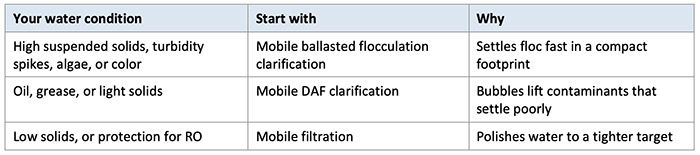
Think of clarification as bulk removal and filtration as polishing.
Ballasted flocculation suits water with high suspended solids. Coagulant destabilizes the particles. Polymer and recycled microsand then build dense floc that settles in a clarification tank. A hydrocyclone separates the sand for reuse. Ballasted floc settles much faster than conventional floc, so tanks can be far smaller.
Dissolved air flotation (DAF) suits solids, oil, and grease that settle poorly. It dissolves air into water under pressure, then releases it as microscopic bubbles that lift contaminants to the surface for removal. Refineries, food processors, chemical plants, pulp and paper mills, and power plants use it.
Filtration suits water that already has low solids, or water that needs protection downstream. Ultrafiltration membranes remove fine particles behind a physical barrier and can work without coagulant addition. That makes them a common pretreatment step for reverse osmosis (RO).
Plan for solids too. Clarification and DAF generate sludge, and it needs a path out. In a full flow sheet, sludge typically moves to thickening, then to a filter press or other dewatering step before disposal. Decide how a temporary system will handle it.
In 2005, a new four-turbine power plant in Lebec, California, faced a filtration failure. Its granular media filters sat upstream of an RO system and passed turbidity spikes of up to 30 nephelometric turbidity units (NTU). RO membranes fouled in less than a day, and two sets failed.
A fully automated ultrafiltration system arrived in less than four days. It was producing treated water within seven days, and silt density index (SDI) stayed below 2.
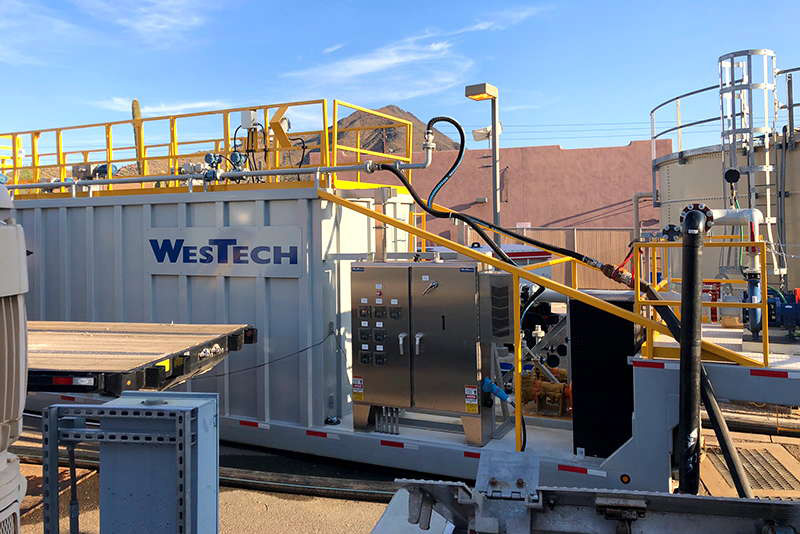
Planned work carries the same stakes. In Cave Creek, Arizona, a filter project meant taking each package treatment plant offline. The town rented a mobile ballasted flocculation train with a pressure filter, treating 500 gpm (114 m³/h). It produced clean water within two to three days of installation.
“Our customers received uninterrupted service, while maintaining all water quality and treatment goals during the filter maintenance project.”
—Jim Kaylor, Town of Cave Creek (WesTech rental treatment system, Cave Creek, Arizona, filter maintenance project)
Wastewater carries the same risk. At a Western U.S. wastewater plant running at a fraction of its capacity, a mobile rental system increased capacity and helped protect 500 jobs at a local poultry plant.
Mobile and rental treatment options cover both clarification and filtration. Ask any provider whether field service can support setup, commissioning, and temporary operation, so your staff can stay focused on production.
Many processes can’t run without treated water or a compliant discharge path. Boilers, cooling towers, and washdown depend on supply. Production also depends on wastewater leaving the site within permit limits. If either path closes, the line has nowhere to go.
Speed depends on equipment availability, site conditions, and utilities. In one documented case, a mobile ultrafiltration system arrived in less than four days and produced treated water within seven days. Pre-planned connection points shorten that timeline.
Any plant that depends on water to operate or discharge it. Food processing, pulp and paper, chemical processing, refining, and power generation are common examples, and each has distinct treatment targets.
Map your water dependencies, then test your water. Bench-scale testing determines settling rates and key design parameters, which helps match the right unit before you need it.
A water failure doesn’t have to become a production failure. Map your dependencies, set your targets, and choose a backstop before the call comes. When the permanent system goes down, a plan keeps treatment, and production, moving.

About the Author:
Colvin Walker is a business advisor at Finders Advisory, where he works with WesTech Water on their growth and visibility strategy. WesTech designs, builds, and maintains equipment and systems for water and wastewater treatment, serving municipal and industrial customers around the world.
Read more from the author:
Charging Is the AMR Decision Nobody Models Until It’s Too Late: How to Get Fleet Charging Right Before It Costs You | Robotics Tomorrow, 8/17/2026

Forging the Next 250 Years: Powering the Next Era of American Manufacturing
In this episode of Industry Insights, Ricky Watts, General Manager, Industrial and Robotics Division at Intel Corporation, explains why the Industry 4.0 groundwork manufacturers have been laying for years is now the foundation for AI at scale. He describes how IT and OT systems are finally coming together, and how agentic AI can pull data from the plant floor, the supply chain and the C-suite to find out why a production line is underperforming. Watts also covers why chips have become strategic infrastructure, the rise of physical AI and robotics in harsh industrial settings, and the skills tomorrow’s workforce will need. He finishes with a layered approach to cybersecurity in software-defined plants.
Get In Touch
Google news and SEO compliant, Industry Today’s state-of-the-art digital media platform offers bespoke media campaigns that target key decision makers and buyers to achieve your marketing and promotional goals.

Contribute
Showcase your brand and promote your business to our highly targeted audience. We offer detailed Google Analytics with measurable ROI to assure success. Submit your content for review by our Editorial team who will contact you to discuss the project further.
About Us
Reach Your Targeted Audience and Grow Your Business. Learn more About Industry Today.
Contact Us

© 2026 Industry today. All Rights reserved.