Workplace pain can take a toll beyond physical discomfort, affecting income, career advancement and long-term opportunities for workers in demanding roles.
By Andrew I. Spitzer, MD, an orthopedic surgeon specializing in adult reconstruction and knee and hip replacements at Cedars-Sinai Medical Center in Los Angeles, CA
A new national survey points to a critical but often underrecognized issue for people in physically demanding roles: pain can shape not only how workers feel, but how they earn, advance, and envision their futures. For many, the instinct is to push through discomfort rather than seek help for it, yet the survey findings suggest that silence may come at a real professional and personal cost. Among tradespeople and laborers specifically, more than half said they would choose a less physically demanding career if they could choose again.
The Standing Strong: The Impact of Pain on America’s Workforce survey, launched by Pacira BioSciences, Inc. and conducted by Wakefield Research, surveyed 1,000 U.S. adults employed full-time who work on their feet at least some of the time. For purposes of the survey, respondents were asked about orthopedic pain related to movement or strain in the knees, back, feet, joints, or muscles. Respondents included tradespeople and laborers, first responders, active-duty military personnel, retail workers, teachers, and food service/hospitality workers.
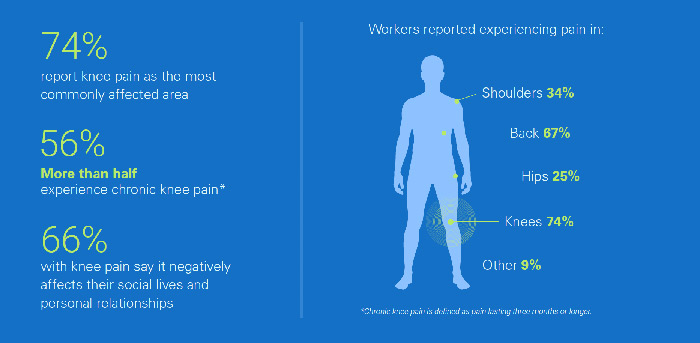
“As an orthopaedic surgeon, I often see patients who normalize pain and adjust their lives around it, which often compromises their physical activity level professionally and personally. Persistent knee pain can affect mobility, function, confidence, and participation well beyond the workday. In addition, reduced activity may have deleterious effects on comorbidities such as obesity, diabetes, and cardiovascular disease. Workers should not assume that pain is simply the price of doing their job; they should feel empowered to speak up and seek care.”
— Andrew I. Spitzer, MD, Analysis
Physically demanding jobs can require long hours standing, walking, lifting, carrying, and moving. While the survey does not establish that respondents’ pain was caused by their work, it highlights how common the high prevalence of pain is among people whose jobs depend on physical endurance. Those demands can place repeated stress on weight-bearing joints, particularly the knees.
In my practice, I regularly see patients who have spent months or even years working around knee pain before seeking care. By then, pain may already be affecting how they move, work, and participate in daily life. Deconditioning often ensues, which worsens the situation further. That is why persistent knee pain should be understood, not dismissed, and addressed early.
Among tradespeople/laborers studied who reported pain at work, 59% identified their knees as a commonly affected area. In addition, 45% of all tradespeople/laborers surveyed reported chronic knee pain, defined as pain lasting three months or longer. These numbers should prompt an important question: how much productivity, opportunity, and quality of life are lost when knee pain is treated as something workers are simply expected to endure?
Pain is especially challenging for employers because it is not always visible, and workers often do not talk about it. Among the tradespeople/laborers who participated in the Standing Strong survey, 81% said they had experienced pain at work and chosen not to tell a supervisor, manager, or colleague. Many cited concerns about how others would perceive them or whether speaking up would affect their hours, role, or job security. That silence can create a blind spot for organizations: employees may still be showing up, but they may not be performing, advancing, or engaging as effectively.
From a physician’s perspective, this is where culture matters. Employers cannot, and should not, diagnose the cause of an employee’s pain. But they can foster a culture of safety in which workers feel comfortable acknowledging persistent symptoms and seeking appropriate care, without risk for negative consequences.
Persistent knee pain can have many causes. One common cause is knee osteoarthritis (OA), a progressive joint disease that affects nearly 15 million Americans. Although the survey did not assess whether participants had been diagnosed with knee OA, in my practice, I see how persistent knee pain can negatively impact patients’ activity, health and quality of life. It can influence whether someone can climb stairs, kneel, carry equipment, keep up with a shift, or continue doing the work and activities that give structure and meaning to daily life. After work, the painful knee that has been exacerbated during the workday compromises their ability to enjoy their time off and rejuvenate for another day of work.
Importantly, chronic knee pain is not limited to older workers. Among respondents ages 45 and older, 28% reported chronic knee pain. Yet workers under 45 were more likely than those 45 and older to report missing work, losing income, and missing career opportunities because of pain. Pain-related consequences can affect workers across career stages. Importantly, pain is not only a late-career concern, it can shape earnings, mobility, and opportunity much earlier than many people expect.
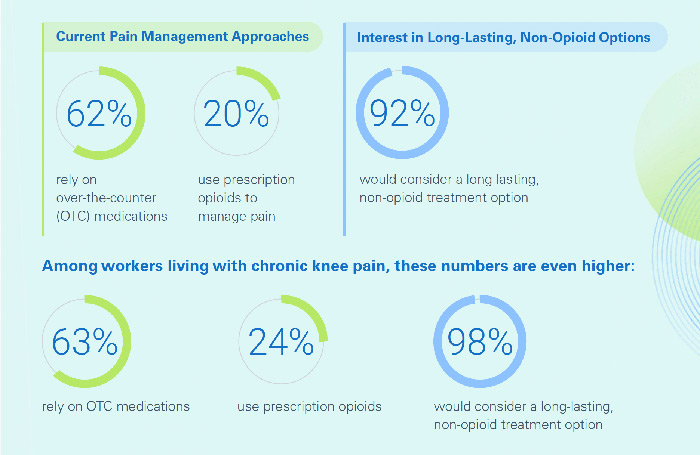
Many workers appear to rely on short-term approaches to manage pain. Among the tradespeople/laborers surveyed who reported pain at work, 64% use over-the-counter medications, while 20% use prescription medications such as opioids or painkillers. Yet 86% of those studied said they would consider a long-lasting, non-opioid treatment option if it provided relief. For workers experiencing persistent pain, these findings reinforce the importance of conversations with healthcare professionals about treatment approaches appropriate for an individual’s symptoms, goals, and daily demands.
Treatment for knee pain is not one-size-fits-all. The right approach depends on the cause of the pain, the severity of symptoms, the patient’s medical history, and the patient’s individual goals. Depending on the patient, management may include exercise or physical therapy, lifestyle modifications, medications, and other targeted approaches. For patients diagnosed with knee OA, one option I use in my practice is ZILRETTA® (triamcinolone acetonide extended-release injectable suspension), an extended-release corticosteroid that can provide both early onset of relief and long-lasting relief. Please see below for ZILRETTA Important Safety Information.
For healthcare professionals and employers alike, the opportunity is to move the conversation upstream, and in fact to change the conversation from simply suffering in silence to understanding the pain, addressing it, and helping workers remain active in the lives they want to lead.
“Every patient with knee OA is different, so treatment decisions should reflect symptoms, function, medical history, and personal goals. In my experience, ZILRETTA can provide reliable and durable pain relief, improving function and reducing reliance on pain medications.”
— Andrew I. Spitzer, MD, Analysis
The survey suggests pain can have implications beyond physical discomfort; it can influence attendance, earnings, engagement, and long-term career decisions. Among tradespeople/laborers, respondents reported impacts on income and career opportunities, while many said they had worked through pain without telling someone. Employers cannot diagnose or treat pain, but they can help create an environment where employees feel comfortable raising concerns and seeking appropriate care.
Jobs that require extended periods of standing, walking, lifting, carrying, or kneeling can place demands on the body. Among tradespeople/laborers experiencing pain at work, 59% identified their knees as a commonly affected area. For workers whose jobs depend on mobility and physical endurance, knee function can be central to both performance and quality of life.
No. Knee OA is a common cause of chronic knee pain, but there are other possible causes. The survey did not assess whether respondents had been diagnosed with OA. Workers experiencing persistent knee pain should talk with a healthcare professional to understand what may be driving their symptoms and what care approach may be appropriate.
Treatment depends on the cause and severity of pain, as well as the patient’s medical history, functional needs, and goals. Options may include physical therapy, activity and lifestyle changes, over-the-counter medications, and non-opioid treatments, such as ZILRETTA. Patients should talk with their healthcare providers to determine which treatment option may be right for them.
Pain can be easy to overlook when workers keep showing up. But the findings from this survey suggest that the effects of working through pain can extend to missed work, lost income, and career decisions. The lesson is clear: persistent pain should not be treated as background noise. It deserves attention from workers, healthcare professionals, and employers who want people to remain mobile, productive, and fully engaged in their lives – on and off the job.

About the Author:
Andrew I. Spitzer, MD, is a Professor in Orthopaedic Surgery at Cedars-Sinai Medical Center in Los Angeles, CA, with over 35 years of experience treating osteoarthritis of the hip and knee and performing hip and knee replacements when indicated. He received his medical degree from the David Geffen School of Medicine at the University of California, Los Angeles, did his residency at the University of Pennsylvania, and a fellowship in adult reconstructive surgery at the Brigham and Women’s Hospital at Harvard Medical School.
Indication and Important Risk Information
What is ZILRETTA?
ZILRETTA® (triamcinolone acetonide extended-release injectable suspension) is an extended-release corticosteroid approved to manage osteoarthritis knee pain. The benefits and risks of repeat injections have not been demonstrated.
Who should not receive ZILRETTA?
You should not receive a ZILRETTA injection if you are allergic to corticosteroids, triamcinolone acetonide, or any other component of the product.
What possible side effects of corticosteroids could occur with ZILRETTA?
What are the most common side effects of receiving a ZILRETTA injection?
In multiple clinical trials, the most common side effects seen in people taking ZILRETTA were joint pain, headache, joint swelling, back pain, sore throat and runny nose, upper respiratory tract infection, and bruising.
What should you tell your doctor BEFORE receiving a ZILRETTA injection?
Tell your doctor about all of the medications you are taking (including both prescription and over-the-counter medicines) and about any medical conditions, especially if you have high blood pressure, heart disease, ulcers, diverticulitis or other gastrointestinal disorders, kidney problems, diabetes, glaucoma, behavior or mood disorders, and/or infections.
What should you tell your doctor AFTER receiving a ZILRETTA injection?
Contact your doctor if you develop a fever or other signs of infection, have an increase in pain along with swelling of the injected knee, restriction of joint motion, or a general feeling of discomfort. Contact your doctor immediately if you are exposed to chicken pox or measles, or for any new or worsening changes in behavior or mood.
These are not all of the possible side effects with ZILRETTA or corticosteroid medications. Please see the full Prescribing Information at www.ZILRETTALabel.com/PI.pdf. Always contact your doctor if you have questions or experience any side effects.
You are encouraged to report negative side effects of prescription drugs to the FDA. Visit www.fda.gov/medwatch, or call 1-800-FDA-1088.
© 2026 Pacira Pharmaceuticals, Inc., a wholly owned subsidiary of Pacira BioSciences, Inc. ZILRETTA is a registered trademark of Pacira Pharmaceuticals, Inc., a wholly owned subsidiary of Pacira BioSciences, Inc. All rights reserved.

Forging the Next 250 Years: Powering the Next Era of American Manufacturing
As manufacturers offer more customization than ever before, managing product complexity has become a critical challenge. Tune in with Dan Joe Barry, Vice President of Product Marketing at Configit, who explores how companies are tackling the growing number of product configurations across engineering, sales, manufacturing, and service. He explains how Configuration Lifecycle Management (CLM) helps organizations maintain a single source of truth for configuration data. The result: fewer errors, faster quoting, and the ability to deliver customized products at scale.
Get In Touch
Google news and SEO compliant, Industry Today’s state-of-the-art digital media platform offers bespoke media campaigns that target key decision makers and buyers to achieve your marketing and promotional goals.

Contribute
Showcase your brand and promote your business to our highly targeted audience. We offer detailed Google Analytics with measurable ROI to assure success. Submit your content for review by our Editorial team who will contact you to discuss the project further.
About Us
Reach Your Targeted Audience and Grow Your Business. Learn more About Industry Today.
Contact Us

© 2026 Industry today. All Rights reserved.