Peak season is when the quick fixes for supplier and customer data break down.
By Tim Bond, Chief Product Officer, Adeptia
At most manufacturers, orders, shipping notices, invoices and stock counts come in from suppliers and customers every day. That data passes through buying, the order desk, operations and IT without a single team in charge of it.
Each team handles its own data. Those solutions hold up most of the time, but come October,, they tend to fail when orders pile up, partners change their files, and the one person who knows what to do is on vacation.
Ask a manufacturer who owns product quality, and you’ll get a name right away. Ask who owns the data suppliers and customers send in, and you get a different answer.
Buyers manage suppliers; the order desk manages customer orders; operations handles data that arrives late or wrong; and IT runs the systems.
Someone still has to turn a partner’s file, PDF or EDI message into something the ERP system can read. Every team does just one piece of that job, so the work gets done on the side, in ways nobody planned for.
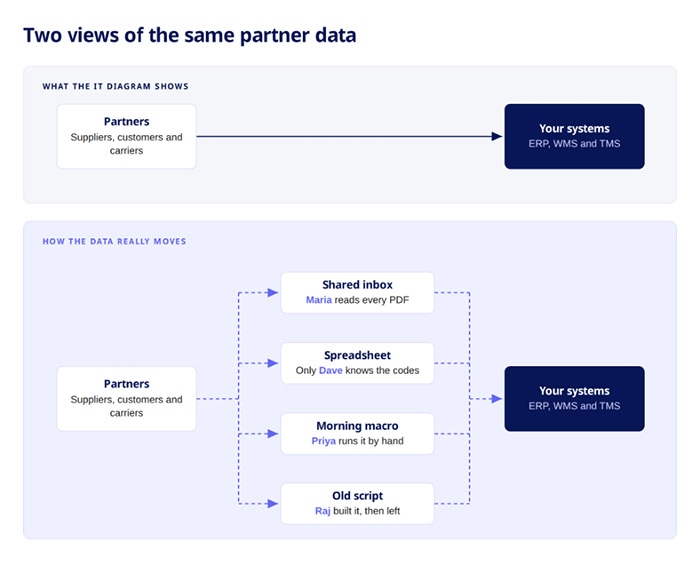
Look at how partner data really gets into your systems, and you’ll find a layer that isn’t on any IT diagram.
A customer service rep uses a spreadsheet to match a retailer’s item codes to your own, while a planner runs a macro each morning to clean up a supplier’s inventory file. Elsewhere, the business still relies on a script an analyst wrote years ago to pull updates from a carrier’s emails, or custom code that only the contractor who built it understands.Every workaround solved a problem at the time. Over the years, though, they’ve become part of how the business runs, supporting real sales without anyone formally responsible for maintaining them, documenting how they work, or stepping in when something breaks.
Each fix is also a data map that holds rules like “this field means X” or “use this code for Y.” Those rules shape how the business runs and live in places most people can’t see.
During peak season, order volume jumps, making a task that took 20 minutes daily take two hours. New partners come on board, like an extra warehouse, a backup trucking company or a new online store, and their files look different from what the spreadsheet expects. Partners also change their file layouts without warning and the people who keep things running take time off in December, like everyone else.
When things go wrong, an order sits in an inbox, a stock file loads with yesterday’s numbers, or a code with errors sends a product to the wrong warehouse. By the time someone spots it, the customer’s delivery has already missed its SLA.
One useful question for any plant leader should be, which orders would stop if your anchor called in sick on December 15?
Customer and supplier data moves through personal spreadsheets, shared inboxes and scripts on someone’s laptop. Prices, bank details and customer records can end up outside the security protocols that protect your main systems. Often, no one records who changed a rule or when.
One dealer and fleet company I’ve worked with, which has several locations, found that a money-making process ran on a homemade tool on one worker’s laptop. The process seemingly worked fine. It was also a single point of failure and a security risk that no leader ever approved.
This happens more than anyone would like to admit and it stays under the radar because it works, right up to the day it doesn’t..
A team can only own the rules it can see. The first step to avoid these challenges is to treat data maps as something the business owns, like equipment or inventory.
That means moving them out of personal spreadsheets and scripts and into one shared place. There, you can track and test each rule. The people who know the data best, analysts, planners, and customer service leads- can read and change the them, and IT sets the standards, reviews changes and governs access.
This is where intelligent ETL comes in. Today’s data mapping tools can pull data out of PDFs, emails, and spreadsheets and suggest how to map a new file based on rules already used. They can also catch odd values before they reach the ERP.
These tools save time. They also provide transparency, so everyone can find them. When the person who built the map is out, someone else can open it and keep things moving.
AI helps here too, with a person still in charge. Someone who owns the rule should check and approve each AI suggestion. That keeps results steady and easy to audit.
Manufacturers have spent years making the factory floor easy to see, measure and manage. The data that tells the factory what to build deserves the same care.
Peak season starts soon. Now is the time to decide who owns that data, before a busy week in December decides for you.

About the Author:
Tim Bond is the Chief Product Officer of Adeptia, where he oversees product strategy and innovation, advancing the company’s AI-native platform as the foundation organizations rely on for building, orchestrating, and scaling their data workflows. Prior to joining Adeptia, Bond was a senior product advisor at various software companies, including Nymbl, Jitterbit, and Zudy, bringing more than a decade of experience leading product strategy and development across data, integration, and enterprise software.

Forging the Next 250 Years: Powering the Next Era of American Manufacturing
Brooklyn Army Terminal (BAT) began as a World War II-era military supply base. Today it is New York City’s largest publicly owned industrial campus, with 59 waterfront acres, more than 4 million square feet and over 100 businesses. In this episode of Industry Insights, Bridget Chansakul, Vice President of Leasing & Portfolio Management at NYCEDC, explains what space is available and what’s planned for the 250,000+ square feet of new industrial space in Building A. She also covers how the ferry, parking and on-site childcare help tenants hire and keep workers, along with workforce partnerships, City incentives for manufacturers and where BAT is headed next.
Get In Touch
Google news and SEO compliant, Industry Today’s state-of-the-art digital media platform offers bespoke media campaigns that target key decision makers and buyers to achieve your marketing and promotional goals.

Contribute
Showcase your brand and promote your business to our highly targeted audience. We offer detailed Google Analytics with measurable ROI to assure success. Submit your content for review by our Editorial team who will contact you to discuss the project further.
About Us
Reach Your Targeted Audience and Grow Your Business. Learn more About Industry Today.
Contact Us

© 2026 Industry today. All Rights reserved.