What does the 2026 U.S. tariff reset mean for manufacturers who can only see as fare as their Tier 1 suppliers?
By Simon Thompson
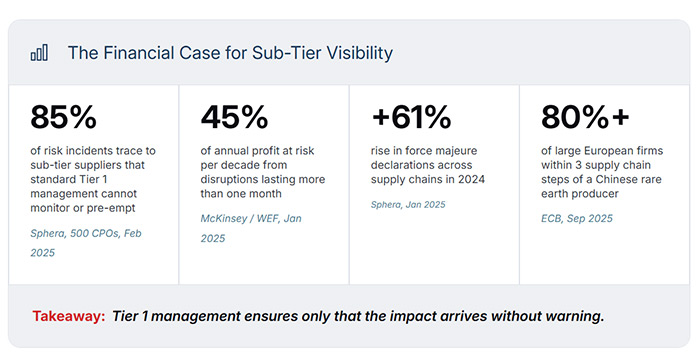
The 2026 U.S. tariff reset is a structural change that will keep generating new exposure across manufacturing supply chains. Most companies have reliable visibility of their direct, Tier 1 suppliers; the risk is instead concentrated precisely where they cannot see: deeper tiers where disruptions more commonly originate. Closing that gap is now more important than ever.
The Section 122 global tariff expired by statute on July 24, 2026. Its replacements, Section 301 and Section 232 duties, carry no built-in sunset clause and no rate ceiling. Opening levies of 10–12.5% have been applied to approximately 60 countries, tied to forced-labour enforcement concerns. This is widely understood as the opening move in a longer sequence, not a concluded policy.
Active probes into industrial overcapacity, intellectual property practices, and national-security exposure across sectors from semiconductors to robotics are already in motion. Each probe is a potential new tariff category. Manufacturers who are mapping their exposure only against current rates are working from a snapshot that could be outdated within weeks.
The aluminium sector illustrates how granular and fast-moving this has become. A White House fact sheet issued on July 20 introduced a Section 232 mechanism allowing companies to apply for reduced tariff rates in exchange for committing to invest in domestic smelting capacity, but Commerce retains the right to claw back that benefit retroactively if onshoring commitments are not met. Any product with aluminium content now carries tariff exposure that can shift based on an upstream commercial decision made somewhere in the supply chain, a decision the downstream buyer may have no knowledge of and no contractual right to access.
“More than a third of all financial risk notifications tracked across global supply chains in 2024 related to deteriorating revenue and growth outlook among suppliers – a warning sign that was already building before the 2026 tariff reset added further pressure.”
—Sphera Supply Chain Risk Report 20253
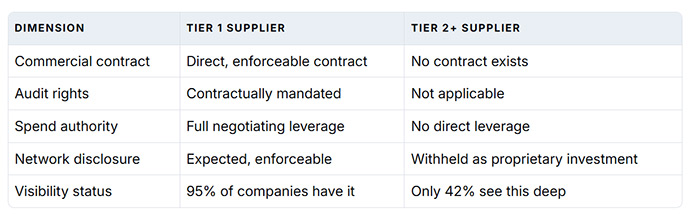
Most procurement platforms were designed around the purchase order as the organising unit. That logic holds at Tier 1, where buyers have contracts, audit rights, and negotiating leverage, but breaks down immediately below that level. Tier 1 suppliers routinely treat their sub-tier networks as commercially confidential, with no obligation or incentive to share that information with buyers.
The result is a structural blind spot that the tariff reset is now directly targeting. A component that was tariff-neutral just weeks ago may now sit within a newly created country grouping, fall under a freshly opened Section 301 investigation, or carry exposure through a raw material sourced two or three tiers upstream. The consequences radiate: more force majeure declarations, quality incidents, and hazardous materials flags reaching procurement teams’ desks, often weeks after the moment when a meaningful response was still possible. That pattern played out clearly following the 2024 tariff reshuffle4, and the conditions for a repeat are now firmly in place.
The risk is compounded by how well-hidden sub-tier concentration can be. A Tier 2 or Tier 3 supplier providing a critical material may be the sole qualified source for that input, even when Tier 1 appears to offer supplier diversity. In automotive and aerospace, a single Tier 1 relationship can rest on dozens of such single-source dependencies. Research from the ECB published in June 2025 found that over 80% of large European manufacturers sit within three supply chain steps of a Chinese rare earth producer5, a dependency that is invisible to most standard procurement systems.
Standard supplier relationship management platforms were not built to answer questions beyond the contracted supplier boundary. By the time a sub-tier disruption works its way up to a Tier 1 scorecard, the window for an effective response has typically already closed. Gartner’s 2026 research found that only 7% of supply chains are equipped to make decisions in real time6. In regulated industries such as aerospace, medical devices, or defence, qualifying an alternative source takes 12 to 24 months, meaning a tariff-driven disruption today becomes a cost that has to be absorbed for years, regardless of what procurement teams do next.
Closing this gap is not a matter of adding more data to existing systems. It requires rethinking where the risk management perimeter sits. The logical boundary is not the purchase order but the production dependency, whether or not a formal commercial relationship exists at that tier.
In practice, that means three things working together. First, a governance framework that extends oversight to every node in the supply network whose failure could propagate upstream, regardless of whether that node is a contracted supplier. Second, continuous enrichment of that network map with live signals: financial distress indicators, geopolitical developments, trade flow data and compliance monitoring updated in real time, not quarterly. Third, technology purpose-built to surface sub-tier relationships that were never explicitly disclosed, mapping dependency through inference and data aggregation rather than relying solely on what Tier 1 suppliers choose to share.
The aluminium proclamation alone demonstrates how quickly individual tariff lines can become conditional, complex, and operationally consequential. Organisations that build this capability now will be able to identify exposure as policy shifts, model the impact before it reaches Tier 1 and act while options still exist.
Tier 1 suppliers treat their own supplier networks as commercially sensitive. There is no standard contractual obligation to disclose sub-tier relationships, and most procurement systems were never designed to capture them. The further down the chain, the less likely any formal record exists at all.
Aerospace, automotive, defence, and medical devices carry the highest risk because of complex multi-tier supply chains and the fact that qualifying an alternative supplier in these sectors typically takes 12 to 24 months. That time lag turns a policy change into a structural cost regardless of how quickly procurement responds.
The immediate priority is shifting the risk management perimeter from the purchase order to the actual production dependency. That means investing in continuous sub-tier monitoring (tracking financial, geopolitical, and trade flow signals across all tiers) rather than waiting for disruption to surface through a Tier 1 scorecard.
The tariff environment taking shape in 2026 will continue to generate new country- and sector-specific measures in the months ahead. Manufacturers that can only see as far as their direct suppliers will keep discovering their exposure after the fact, long after the warning signs first appeared deeper in the chain. The organisations best placed to absorb what comes next are those building multi-tier visibility now, not after the next proclamation lands.

About the Author
Simon Thompson is VP UK & Nordics at JAGGAER, bringing over 20 years of experience delivering procurement technology solutions across commercial, public sector and not-for-profit organisations. Previously with SAP Ariba and Ivalua, he has supported businesses across Europe, the US, Australia and India in implementing Source-to-Pay solutions that address cost optimisation, supply chain resilience and risk mitigation. Simon specialises in helping organisations navigate the adoption of AI and ESG within complex, commercially volatile environments.
1 McKinsey Supply Chain Risk Pulse, 2025 · Sphera, 500 CPOs, February 2025
2 Ibid.
3 Sphera, Sphera Supply Chain Risk Report 2025
4 Sphera, Sphera Supply Chain Risk Report 2025
5 ECB, How vulnerable is the euro area to restrictions on Chinese rare earth exports?, 6/2025
6 Gartner, Reshaping Supply Chain for the Future, 2026
Forging the Next 250 Years: Powering the Next Era of American Manufacturing
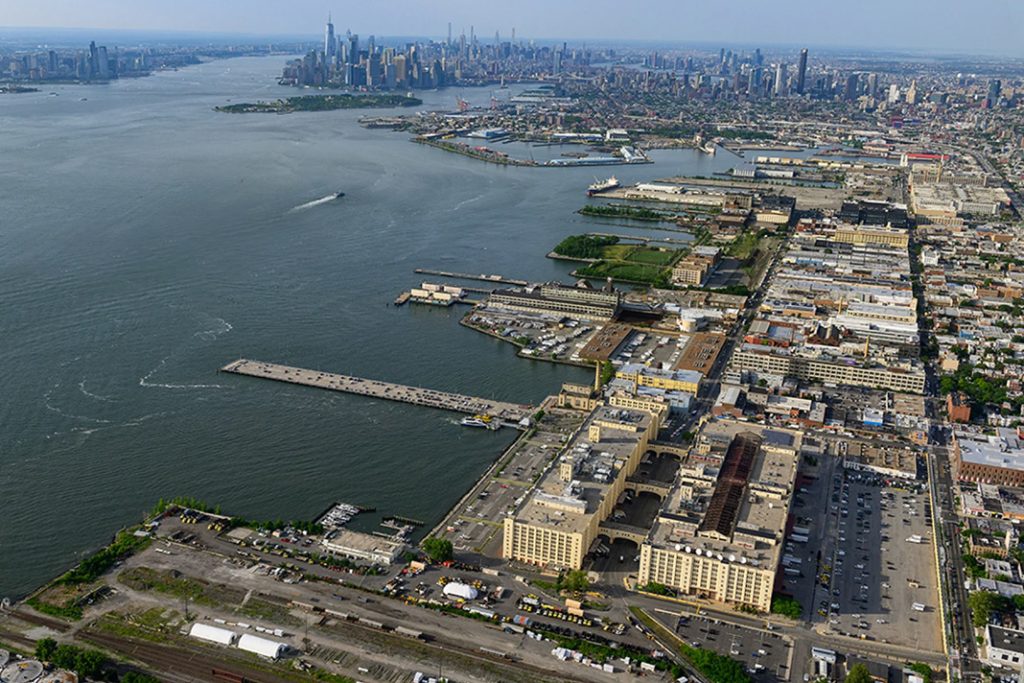
Brooklyn Army Terminal (BAT) began as a World War II-era military supply base. Today it is New York City’s largest publicly owned industrial campus, with 59 waterfront acres, more than 4 million square feet and over 100 businesses. In this episode of Industry Insights, Bridget Chansakul, Vice President of Leasing & Portfolio Management at NYCEDC, explains what space is available and what’s planned for the 250,000+ square feet of new industrial space in Building A. She also covers how the ferry, parking and on-site childcare help tenants hire and keep workers, along with workforce partnerships, City incentives for manufacturers and where BAT is headed next.
Get In Touch
Google news and SEO compliant, Industry Today’s state-of-the-art digital media platform offers bespoke media campaigns that target key decision makers and buyers to achieve your marketing and promotional goals.

Contribute
Showcase your brand and promote your business to our highly targeted audience. We offer detailed Google Analytics with measurable ROI to assure success. Submit your content for review by our Editorial team who will contact you to discuss the project further.
About Us
Reach Your Targeted Audience and Grow Your Business. Learn more About Industry Today.
Contact Us

© 2026 Industry today. All Rights reserved.