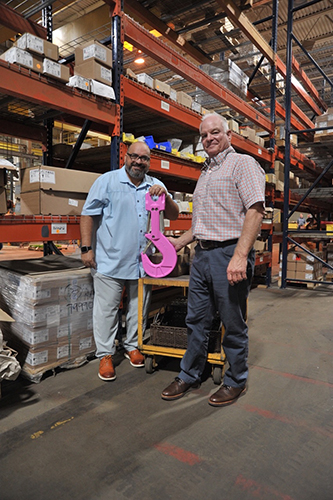
The Caldwell Group Inc. has added remotely operated vehicle (ROV) hooks from RUD to its in-stock program.
Rockford, Illinois-based The Caldwell Group Inc. has added remotely operated vehicle (ROV) hooks from RUD to its in-stock program.
The hooks, available in 10t and 25t capacity, are supplied through Caldwell’s dealer network, primarily for use in underwater applications in the Gulf Coast region. Caldwell and the RUD Group unite their sales and marketing activities in North America, and now stock more ROV hooks here than ever before.
Access to ROV hooks is important to major subsea, and oil and gas, contractors for utilization in multi-million-dollar projects to handle valuable loads in hazardous environments, often many miles offshore and up to water depths of 10,000 ft.
The safe lifting and lowering of loads on deck and underwater—coupled with ambient conditions, unpredictable currents, and difficult lighting—presents enormous challenges. The sector is nearly always time pressured, and precision is fundamental to safety.
The hooks can be used by major contractors, like Oceaneering International Inc., to install long baseline transponder frames, rigid M-shape jumpers, and associated subsea distribution hardware, for example. Users must eliminate the risk of dropped objects, especially when passing through the water interface, and provide a user-friendly subsea solution.
The RUD ROV hooks can be operated by all commonly used ROV manipulators, including the grabber. The hook eliminates the risk of snagging and accidental rigging; the outer profile is smooth with no protruding hook nose. The outwardly opening safety latch, which can be operated by a single manipulator, automatically closes when the ROV releases the triggers, and it is securely locked in closed position. Overall hook design minimizes the time the ROV takes to carry out the attachment / detachment operation.
Jay Schroeder, western sales manager at Caldwell, said: “Just like every other market segment, when someone needs it, they need it now. Many times, you can’t anticipate when you have a failure or an emergent need, and it is important to keep the job running. Overall, it is important we have these hooks in stock. The equipment our ROV hooks are lifting is often worth well over a million [dollars].”
A standout feature of RUD ROV hooks is the twin trigger mechanism; it opens only by pressing both triggers simultaneously. It only requires one hand to operate whereas most alternatives need two hands to open and close. The yellow oblong master link serves as the target for operators. Radio-frequency identification (RFID), meanwhile, enhances inspection and tracking.
Schroeder added: “RUD is a high-quality, Germany-manufactured product, so it takes a certain type of company to be able to deliver it here in North America, keeping lead times short and stock levels high, close to the point of use.”
Contact for editorial inquiries: Lisa Sympson, lsympson@caldwellinc.com

Forging the Next 250 Years: Powering the Next Era of American Manufacturing
In this episode of Industry Insights, Ricky Watts, General Manager, Industrial and Robotics Division at Intel Corporation, explains why the Industry 4.0 groundwork manufacturers have been laying for years is now the foundation for AI at scale. He describes how IT and OT systems are finally coming together, and how agentic AI can pull data from the plant floor, the supply chain and the C-suite to find out why a production line is underperforming. Watts also covers why chips have become strategic infrastructure, the rise of physical AI and robotics in harsh industrial settings, and the skills tomorrow’s workforce will need. He finishes with a layered approach to cybersecurity in software-defined plants.
Get In Touch
Google news and SEO compliant, Industry Today’s state-of-the-art digital media platform offers bespoke media campaigns that target key decision makers and buyers to achieve your marketing and promotional goals.

Contribute
Showcase your brand and promote your business to our highly targeted audience. We offer detailed Google Analytics with measurable ROI to assure success. Submit your content for review by our Editorial team who will contact you to discuss the project further.
About Us
Reach Your Targeted Audience and Grow Your Business. Learn more About Industry Today.
Contact Us

© 2026 Industry today. All Rights reserved.