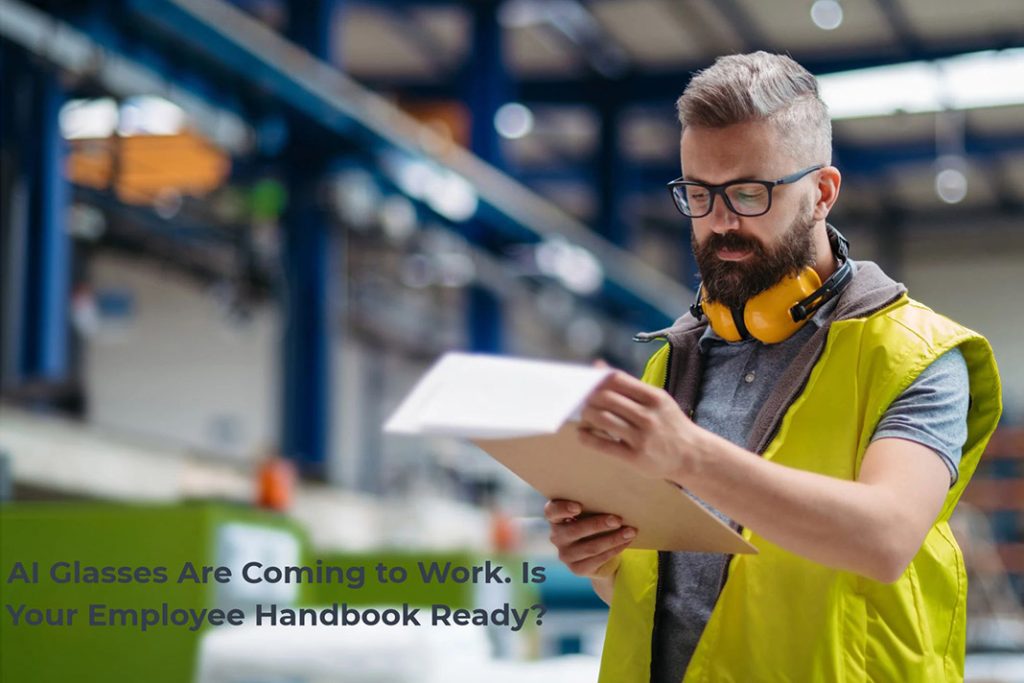
How should manufacturers manage AI-powered smart glasses in the workplace?
By Michael Goldfarb, esq.
Is anyone wearing glasses to work considered a corporate espionage risk? While glasses with recording capabilities have long-been available, the newest models, including Meta AI glasses, can be undetectable and represent a risk for both employee interactions and trade secrets.
This means employers need to update workplace policies to address recording consent, confidential information, trade secrets, AI uploads and employee rights ahead of 2027, before these devices become normalized on the plant floor.
The objective is to establish clear boundaries for a technology that can capture the workplace far more discreetly and clearly than a traditional camera or smartphone.
A smartphone held up during a production meeting or plant tour is obvious. A pair of glasses may not be. That matters in any industry, but can be especially difficult to navigate in manufacturing environments which contain proprietary processes, prototypes, computer systems, confidential documents and customer information.
Meta says its glasses use a visible Capture LED that blinks when photos are being captured and remains active during video recording. For the latest generation of products, it says if the camera is tampered with, the glasses won’t work. Those safeguards are useful, but employers should not outsource their privacy and confidentiality policies to a device manufacturer. Copycat devices won’t necessarily maintain the same visual cues, and there are even keychains set to debut with recording and AI capabilities.
If a device can see, hear, record or transmit what happens inside your workplace, your policies should address it by capability. That means policies should address smart glasses, AI wearables and other devices capable of audio, video, photography, data capture or AI processing. An existing cell phone policy needs to be expanded and amended.
Recording-consent laws present an immediate concern. Most states generally follow a one-party consent model, while states including California and Florida impose all-party consent requirements. For employers operating across multiple states, a recording that is permissible in one jurisdiction may create legal exposure in another.
Instead of expecting employees to understand a state-by-state patchwork, multi-state employers should choose a more protective companywide approach requiring clear notice and appropriate consent before workplace conversations are recorded, glasses recordings included.
A simple practice can eliminate considerable ambiguity: announce at the beginning of a recorded meeting that recording or transcription is occurring and provide participants an opportunity to raise concerns.
For manufacturers, workplace recording is not solely an HR issue. It can be an intellectual-property issue.
Imagine an employee, visitor or contractor walking through a facility while wearing glasses capable of capturing a proprietary production line, unreleased products or specialized machinery. Information previously protected by physical access can suddenly leave the facility digitally.
This makes existing confidentiality language worth revisiting. Employers cannot simply label something a trade secret and assume it is protected. They need procedures treating the sensitive information as confidential, including controls governing who can access it and under what circumstances.
Manufacturers need to identify especially sensitive zones within their plants and establish specific technology rules around them. Depending on the operation and the sensitivity of the information, that could mean prohibiting recording-capable personal devices in specific environments rather than imposing an unnecessarily broad facility-wide ban.
In 2026, the U.S. Air Force prohibited smart glasses with photo, video or AI capabilities while personnel are in uniform, citing operational-security concerns. Manufacturers need to emulate this policy, especially in defense manufacturing.
Employers should resist the temptation to solve the smart-glasses problem by simply declaring, “No recording, ever.”
Section 7 of the National Labor Relations Act protects employees’ right to engage in concerted activity concerning workplace issues. The National Labor Relations Board states that employers cannot interfere with employees exercising those rights.
Recording restrictions therefore need to be carefully drafted. Depending on the circumstances, employees may have legally protected reasons for documenting working conditions or acting together regarding terms and conditions of employment.
Recent NLRB developments underscore the importance of precision. In January 2026, an NLRB administrative law judge upheld an employer recording policy after concluding that its language did not reasonably prohibit protected Section 7 activity. The policy identified legitimate interests including protecting proprietary information and trade secrets, complying with state recording laws and encouraging candid workplace discussions.
The lesson is not that every recording ban is safe. It is that employers should identify legitimate business interests, define prohibited conduct precisely and include appropriate protections or exceptions for legally protected activities.
Recording is only the beginning. An image of a production process or an employee conversation can potentially be uploaded to an AI system to be analyzed, reproduced, modified or disseminated. That makes AI-specific language increasingly important.
An updated policy should address when workplace audio, images, video, documents or other sensitive information may not be uploaded to public or unauthorized AI platforms. The issue deserves particular attention wherever information involves biometric information or proprietary manufacturing processes.
Now is the time to audit existing policies before a problem occurs. If the employee handbook talks only about smartphones and computers, it may already be behind the technology employees bring into the workplace. Employers should not respond to every new technology with fear, but waiting for the first lawsuit over AI glass recordings isn’t a strategy.
The better approach is to revise the employee handbook now. Understand what these devices can capture, addresses recording consent, identify what trade secrets must be protected, limit unintended exposure to AI and establish clear rules before there’s a dispute.

About the Author:
Michael Goldfarb, esq., is a distinguished employment law attorney with over 30 years of experience. During his illustrious career, he has counseled companies of all shapes and sizes and has conducted numerous jury trials. As an experienced litigation defense attorney, Mr. Goldfarb identified a demand within the human resources industry that prompted him to create Guardian HR – an organization that provides employers with access to a one-stop shop for unlimited HR and legal support within a single package.

Forging the Next 250 Years: Powering the Next Era of American Manufacturing
Brooklyn Army Terminal (BAT) began as a World War II-era military supply base. Today it is New York City’s largest publicly owned industrial campus, with 59 waterfront acres, more than 4 million square feet and over 100 businesses. In this episode of Industry Insights, Bridget Chansakul, Vice President of Leasing & Portfolio Management at NYCEDC, explains what space is available and what’s planned for the 250,000+ square feet of new industrial space in Building A. She also covers how the ferry, parking and on-site childcare help tenants hire and keep workers, along with workforce partnerships, City incentives for manufacturers and where BAT is headed next.
Get In Touch
Google news and SEO compliant, Industry Today’s state-of-the-art digital media platform offers bespoke media campaigns that target key decision makers and buyers to achieve your marketing and promotional goals.

Contribute
Showcase your brand and promote your business to our highly targeted audience. We offer detailed Google Analytics with measurable ROI to assure success. Submit your content for review by our Editorial team who will contact you to discuss the project further.
About Us
Reach Your Targeted Audience and Grow Your Business. Learn more About Industry Today.
Contact Us

© 2026 Industry today. All Rights reserved.