Manufacturers must be bold with how they empower the workforce with data if they are to drive sustained improvements in 2026.
By Steve Adams
Beverage manufactures are facing various compounding, strategic challenges. Business uncertainty has triggered rising operational costs and a volatile supply chain, putting market confidence on the line. Labour shortages and a growing skills gap are limiting expertise on the factory floor, while leadership churn – where senior leaders move roles and take their knowledge with them – remains an ongoing business concern. What’s more, evolving consumer buying habits are increasing complexity across production lines. For example, growing demand for more sustainably produced products has prompted the introduction of new manufacturing materials and processes, such as ‘lightweighting’ of cans to reduce the material used.
Manufacturers may feel as though they’re swimming against the tide, but new opportunities in manufacturing intelligence are helping to deliver efficiency gains – and they put data and optimisation at the top of the business agenda.
Manufacturers generate astounding volumes of data; ABI Research projects that industrial enterprises globally will generate a total of 4.4 Zettabytes (ZB) of data by 2030, up from 1.9 ZB in 2023. This data is crucial for informing KPIs, driving production improvements and benchmarking performance. It also helps businesses unlock productivity gains by highlighting hidden inefficiencies across production lines.
Crucially, production data should illustrate the overall operational health of lines, systems, and equipment. It needs to be accurate, up-to-date, relevant, and contextualised, otherwise it cannot support decision making or power long-term improvements.
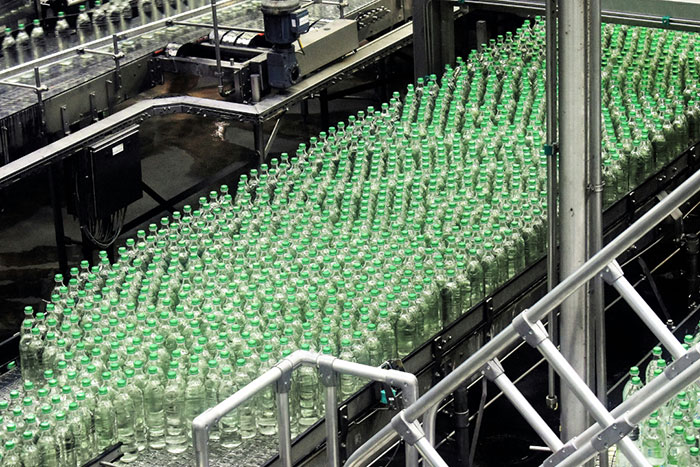
Consider the production of sparkling mineral water. If a large-scale production facility relies on CO2 monitors to measure the carbon levels for each bottle, and the CO2 injection sensor malfunctions, the bottles could be receiving more CO2 than is needed. If the line monitor data is delayed, this spike in carbonation would not be flagged in real time, thus delaying intervention. This puts the bottles at risk of exploding (potentially creating a health and safety risk) or ruining stock (requiring sanitation and temporary line shutdown). If the manager is unaware of when the over-pressurisation began, thousands of bottles would need to be tested or destroyed.
Success relies on factory teams having access to the right data but also being able to interpret, prioritise, and act on the data available. Factory teams need to now consider the best way to use data to make the right decisions at the right time.
Manufacturing data needs to guide action and support decision making – particularly in high-pressure, time-critical environments. But this is where data becomes somewhat of a double edged sword. It’s not uncommon for teams to feel overwhelmed. Data overload can significantly increase the amount of time lost to over interpretation, delaying critical decision making.
Factory workers have to mentally navigate masses of data on a chaotic dashboard, without any indication of where to start or what to prioritise. This can then trigger ‘analysis paralysis’, where overthinking, procrastination, or the fear of making the wrong decision delays or impedes action.
Analysis paralysis often causes factory teams to wait until they have 100% of the data to guide action. This may seem like the logical solution, but in reality this wastes valuable time which can prove costly. The below example demonstrates the cost of waiting:
Data from a high-speed water bottling line indicates that the Overall Equipment Effectiveness (OEE) is 10% lower than the previous shift. The dashboard is suggesting that there is a high frequency of uncategorised minor stops.
Decision 1: the factory team observes the line for 10 minutes to try and identify the cause of the minor stops. They suspect – based on their experience and using 80% of the data – that some bottles are overlapping as they enter the labeller feed screw due to a guide rail coming loose. The team uses a short window between batches to review the guide rail. Within 10 minutes, the team fixes the issue, the overlapping stops, the minor stops reduce, and the OEE stabilises.
Decision 2: the factory team waits for 100% data accuracy. This involves a week-long analysis of the line to explore the potential causes. After a few days, the report confirms that a loose guide rail was causing bottles to overlap, just as the team suspected. However, this delay was costly – it equated to more than 100,000 unproduced units.
In the above example, taking action based on enough data (80%) drives far more agile operations than waiting for full data. In the first scenario, the operators were trusted to take action and were able to act under the reassurance that they were potentially avoiding a major production issue. In the second, although they were acting based on ‘more accurate’ data, the consequence of waiting meant that they were ultimately operating in the rear view mirror. The major difference is that the team in decision one felt empowered to act at the right time.
This illustrates the impact of how decision making is framed on the factory floor. Manufacturers should value confidence over completeness and give teams permission and power to operate within clear escalation thresholds.
Factory teams must be able to identify what is affecting a bottleneck and intervene quickly to minimise disruption – without always needing, or waiting for, input from time poor senior leadership teams. The C-suite and other executive stakeholders need to focus on higher level strategic outcomes that align with board-level priorities, rather than be drawn into the technical metrics associated with day-to-day operations.
Investing the time into upskilling operators, engineers and team leaders in these areas will improve their knowledge of what the production lines are recording, and will also give them the confidence to make business-critical decisions that can avoid catastrophe. Real-time analytics can only deliver a direct business impact if teams can both interpret the data and remediate issues before they disrupt operations.
Fortunately, advancements in data intelligence tools are helping factory teams with decision making by presenting and prioritising key data points that guide them towards the most effective next step. These tools filter out the noise, identifying where potential issues may arise and highlight where existing issues stem from.
Beverage manufacturers will continue to navigate uncertainty this year, but the most successful businesses will be those that help their teams adapt to it. Existing and emerging technologies – particularly in AI and agentic AI – will become key enablers for improving production line efficiencies. As these become increasingly integrated into workflows, factory teams will become more confident and quicker at intervening under time pressure, which will prove critical in establishing a competitive advantage in the market. After all, the advantage will ultimately belong to those who can simplify processes, empower teams with good data, and then trust their people to make decisions.

About the Author:
Steve Adams is CEO at Lineview.
Joining in 2022, he brings world-class expertise in global operations and data-driven manufacturing transformation to the Lineview leadership team, further reinforcing the company’s position as an industry powerhouse. As the Former Vice President of Supply Chain at Coca-Cola European Partners, Adams has expertise across all levels of the supply chain, including developing and sharing best practice, globally. Beyond supply chain improvements, his strengths focus on digitising manufacturing and offering guidance on how best to deploy intelligent data-driven solutions to achieve a return on investment.

Forging the Next 250 Years: Powering the Next Era of American Manufacturing
As manufacturers offer more customization than ever before, managing product complexity has become a critical challenge. Tune in with Dan Joe Barry, Vice President of Product Marketing at Configit, who explores how companies are tackling the growing number of product configurations across engineering, sales, manufacturing, and service. He explains how Configuration Lifecycle Management (CLM) helps organizations maintain a single source of truth for configuration data. The result: fewer errors, faster quoting, and the ability to deliver customized products at scale.
Get In Touch
Google news and SEO compliant, Industry Today’s state-of-the-art digital media platform offers bespoke media campaigns that target key decision makers and buyers to achieve your marketing and promotional goals.

Contribute
Showcase your brand and promote your business to our highly targeted audience. We offer detailed Google Analytics with measurable ROI to assure success. Submit your content for review by our Editorial team who will contact you to discuss the project further.
About Us
Reach Your Targeted Audience and Grow Your Business. Learn more About Industry Today.
Contact Us

© 2026 Industry today. All Rights reserved.