What risks does this invisible workforce create for manufacturers?

By Dr. Oakley Cox-Robinson
In manufacturing, AI agents can improve production, quality control, maintenance, and supply chain operations, but they also create a new category of cyber and operational risk, with 87% of cybersecurity leaders viewing AI-related vulnerabilities as the fastest-growing cyber risk. Because these systems can make decisions and act autonomously across IT and operational technology environments, a compromise can impact yield or even shut down a facility. The key challenge for manufacturers is balancing AI-driven efficiency with visibility, governance, and security controls that can keep pace with autonomous systems.
“The organizations that succeed will be those that pair responsible AI adoption with equally advanced cyber defenses. As AI agents become embedded across production lines, supply chains, and operational workflows, the need for security that can understand behavior, not just static rules, and respond at machine speed becomes a business imperative.”
– Dr. Oakley Cox-Robinson, Senior Director of Product at Darktrace
Manufacturers have long operated complex environments that blend legacy operational technology with modern digital infrastructure. AI adoption is accelerating this convergence by connecting physical production systems, business applications, and external partners through increasingly integrated digital workflows.
The operational benefits are substantial. For instance, at Schneider Electric, when a shipment is damaged or a port is delayed, its AI system can reroute supply, shift production to an alternative facility, and trigger a replacement shipment within 24 hours, helping cut inventory-on-hand by six days, generating over €100 million in value. These deployments illustrate both the operational value of AI and the importance of securing systems that can influence physical production and supply chain decisions.
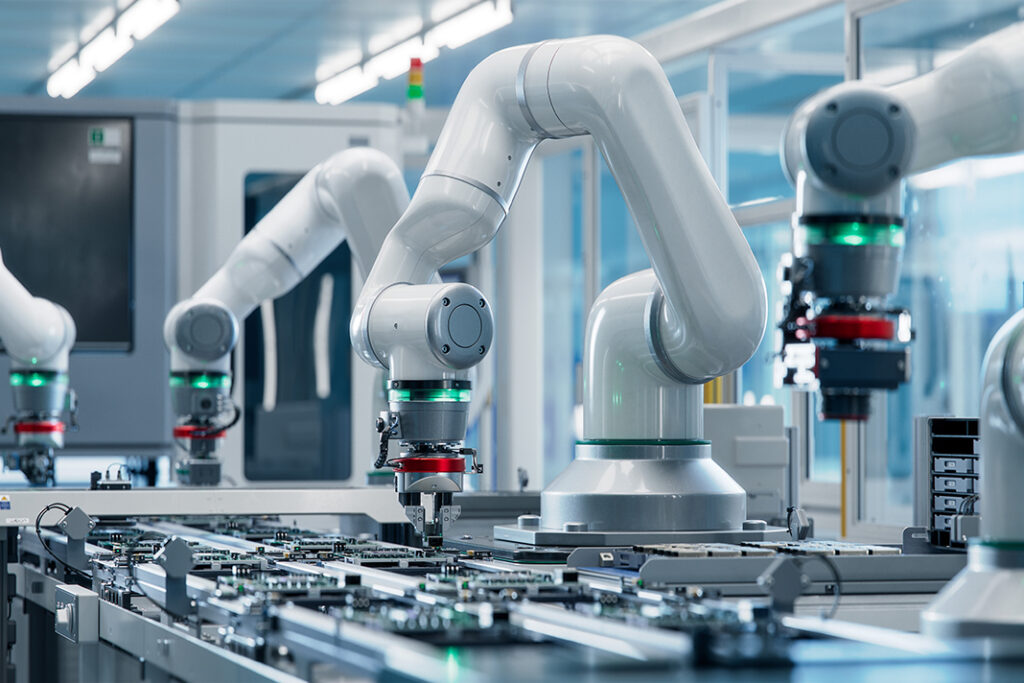
Manufacturers are also using AI to improve quality assurance, predictive maintenance, inventory management, and workforce productivity. At BMW, AI-powered systems monitor hundreds of weld points on vehicle frames to identify defects in real time, helping improve product quality and reduce costly rework. Across the sector, AI has moved beyond analysis and recommendations to taking direct action, making decisions that can have immediate operational consequences.
This shift fundamentally changes the cyber risk equation. Historically, many cyber incidents have centered on data theft, espionage, or business disruption within IT environments. As AI agents in manufacturing become more integrated, they gain visibility into production processes and, in some cases, the ability to influence operational decisions with real-world consequences.
An AI-driven maintenance system operating on corrupted data could overlook signs of impending equipment failure, resulting in unexpected downtime and lost production. Because these systems often operate at machine speed, disruptions can spread before human operators recognize the problem.
In highly regulated sectors such as automotive, aerospace, pharmaceuticals, and food production, the consequences could extend beyond financial losses to include compliance violations, safety concerns, reputational damage, and broader supply chain disruptions that affect customers and partners alike. As AI adoption accelerates, these risks are increasingly becoming board-level concerns with direct implications for revenue growth, operational resilience, regulatory compliance, and corporate reputation.
To address these challenges, manufacturers must stop treating AI security as an IT issue. The answer is not simply deploying more security tools or additional firewalls. Organizations need governance frameworks that apply the same rigor to AI oversight as they do to financial controls and enterprise risk management. This begins with establishing executive accountability for AI systems, defining clear policies for autonomous decision-making, and ensuring boards have visibility into how AI agents are influencing critical business and production processes.
Effective AI agent governance should focus on three priorities. First, organizations must maintain comprehensive visibility in where AI agents operate, what systems they can access, and what decisions they are authorized to make. Second, it is imperative for manufacturers to implement behavioral guardrails that define acceptable actions, escalation procedures, and human-review requirements for high-impact decisions affecting production, quality, safety, or supply chains. Third, boards and leadership teams should regularly assess AI-related risks through audits, performance reviews, and governance programs that evaluate not only cybersecurity exposure but also operational, regulatory, and reputational implications.
Effective oversight requires continuous monitoring of how AI agents perform over time, how their decision-making evolves, and whether new vulnerabilities or unintended consequences emerge as systems adapt to changing business conditions. Governance programs should empower security and operations teams to investigate anomalies quickly, reduce noise from routine activity, and focus attention on the events most likely to create business impact.
The manufacturers best positioned for the future will be those that combine responsible AI adoption with strong visibility, contextual understanding of their environments, and clear guardrails governing how autonomous systems operate. When boards take a proactive approach to AI oversight, they not only reduce risk but also transform AI from a potential liability into a strategic advantage—unlocking innovation, operational efficiencies, and new revenue opportunities while maintaining accountability and trust.

Traditional automation follows predefined rules. AI agents can make decisions, adapt to changing conditions, and interact with multiple systems autonomously, which expands the potential impact of a compromise.
Start with visibility and governance. Organizations need to know where AI is being used, what permissions agents have, what systems they interact with, and whether unauthorized AI tools are operating inside the business. From there, leadership teams should establish clear accountability, behavioral guardrails, and board-level oversight for AI systems that influence production, quality, safety, or supply chain operations.
Quality assurance, predictive maintenance, production planning, procurement, and supply chain management are among the functions seeing significant AI adoption and associated risk exposure.
Yes. AI can help security teams detect anomalies, prioritize threats, and respond more quickly. Many manufacturers report that AI-powered security tools improve the speed and efficiency of cyber response.

About the Author:
Dr. Oakley Cox-Robinson is Darktrace’s Senior Director of Product responsible for all cyber attack detection and response products used to hybrid networks, including NDR, Cloud, and OT. He works with Darktrace’s global customer base to gather feedback and drive R&D innovation and product development. He draws on 7 years’ experience as a Cybersecurity Consultant to organizations across EMEA, APAC and ANZ.
Read more from the author:
How AI Adoption Is Creating Unseen Vulnerabilities on the Factory Floor | Industrial Equipment News, May 28, 2026
From Efficiency to Exposure: How AI Adoption Is Creating Unseen Vulnerabilities on the Factory Floor | Darktrace Blog, May 28, 2026

Forging the Next 250 Years: Powering the Next Era of American Manufacturing
As manufacturers offer more customization than ever before, managing product complexity has become a critical challenge. Tune in with Dan Joe Barry, Vice President of Product Marketing at Configit, who explores how companies are tackling the growing number of product configurations across engineering, sales, manufacturing, and service. He explains how Configuration Lifecycle Management (CLM) helps organizations maintain a single source of truth for configuration data. The result: fewer errors, faster quoting, and the ability to deliver customized products at scale.
Get In Touch
Google news and SEO compliant, Industry Today’s state-of-the-art digital media platform offers bespoke media campaigns that target key decision makers and buyers to achieve your marketing and promotional goals.

Contribute
Showcase your brand and promote your business to our highly targeted audience. We offer detailed Google Analytics with measurable ROI to assure success. Submit your content for review by our Editorial team who will contact you to discuss the project further.
About Us
Reach Your Targeted Audience and Grow Your Business. Learn more About Industry Today.
Contact Us

© 2026 Industry today. All Rights reserved.