Why are companies treating reverse logistics as a margin decision rather than as a cost of doing business?
Returns, repairs, asset recovery, and refurbishment have grown into significant business functions that directly affect profitability. As organizations deploy more technology assets across employees, customers, and field operations, the value tied to returned devices continues to increase. Companies that focus only on processing costs often overlook the larger opportunity: preserving asset value through disciplined recovery, repair, redeployment, and secure disposition.
Returns are no longer a rounding error. U.S. retailers expected 15.8% of annual sales to be returned in 2025, representing roughly $849.9 billion in merchandise, according to the National Retail Federation and Happy Returns.
Organizations managing technology assets face a similar challenge. Devices routinely return through refresh programs, lease expirations, repairs, and employee offboarding, and the decisions made after return often determine whether value is preserved or lost.
What was once viewed primarily as an operational expense is increasingly recognized as a margin decision.
At the same time, rising device costs, ongoing component constraints, and growing demand for affordable technology are increasing the value of recovering, refurbishing, and redeploying assets rather than replacing them outright.
“The next major efficiency gain in supply chain is not moving products forward faster. It is managing what comes back with the same discipline, visibility, and accountability applied to everything else.”
— Jay Ford, CEO, Premier LogiTech
Ask a supply chain executive how a returns operation is performing, and the answer is often tied to cost. Cost per unit processed, transportation expense, labor efficiency, and budget adherence are common measures.
A low-cost returns operation can still destroy value if devices are incorrectly classified, delayed in processing, or routed to inappropriate disposition channels. Conversely, a program with slightly higher processing costs may generate significantly better outcomes if it maximizes repair rates, refurbishment opportunities, and resale value.
Recovery rate is often the more meaningful measure. It reflects how much economic value an organization preserves from returned assets through repair, redeployment, resale, parts harvesting, recovery programs, and increasingly certified pre-owned channels.
According to Deloitte research cited by the National Retail Federation, businesses with optimized reverse logistics can recover up to 65% of the original value of returned items in best-case scenarios.
Much of that value recovery depends on identifying the highest-value disposition path. High-grade devices may qualify for certified pre-owned programs or like-new replacement channels, while lower-grade assets may still generate meaningful returns through refurbishment, parts harvesting, or secondary-market resale.
Every returned device follows a path.
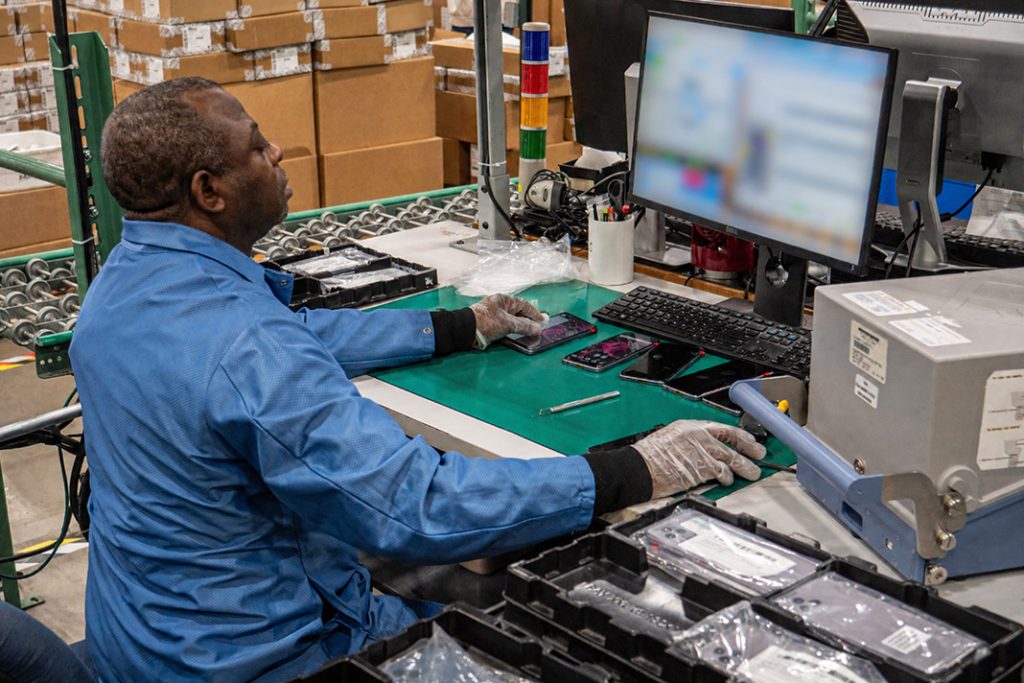
Some are suitable for immediate redeployment. Others require repair before returning to service. Some enter secondary markets or insurance programs. Others have reached end of life.
The quality of the initial assessment often determines whether value is preserved or lost. Devices that are graded too conservatively may be replaced unnecessarily. Devices that are graded too optimistically may consume repair resources that exceed their residual value.
Even modest refurbishment efforts can materially affect recovery value. Cosmetic improvements that restore a device’s appearance may increase its marketability and create opportunities for higher-value resale channels.
For that reason, grading accuracy, intake-to-disposition cycle time, recovery rate, and dispute rate are often stronger indicators of reverse logistics performance than throughput alone.
These metrics reflect decision quality, not simply processing speed.

The economics of reverse logistics are only part of the story.
Organizations across healthcare, financial services, government, telecommunications, and enterprise technology must also maintain control of sensitive devices as they move through the returns process.
Returned devices often contain sensitive business or customer information. Even when devices are encrypted, organizations are expected to maintain documented chain of custody and secure handling procedures.
Reverse logistics now sits at the intersection of performance and risk management.
A device that cannot be accounted for may create far greater exposure than the value of the hardware itself.
Documented chain of custody, secure handling and verifiable asset tracking have become essential requirements rather than optional services.
Historically, reverse logistics was often addressed late in the procurement process. Organizations focused primarily on acquisition costs, deployment capabilities, and service levels.
Today, buyers increasingly evaluate what happens after deployment.
Larger technology fleets, growing sustainability requirements, and stricter compliance expectations are changing how organizations evaluate asset disposition.
As a result, procurement teams are asking different questions. Who performs the recovery work? What certifications are maintained? How is chain of custody documented? What percentage of assets are successfully recovered, repaired, or redeployed?
Reverse logistics capabilities are becoming part of vendor evaluation because the financial and operational implications are now too significant to ignore.
Procurement leaders are also evaluating providers based on their ability to maximize recovery value through refurbishment, certified pre-owned programs, and secondary-market opportunities.
Throughout more than three decades in logistics leadership, I have seen a consistent pattern.
Large-scale logistics operations succeed because every handoff is measured and documented. The same principle applies to reverse logistics.
Organizations that generate strong recovery outcomes typically share several characteristics. They use documented processes, consistent grading standards, clear disposition paths, and measure recovery value alongside operating costs.
These are not complicated concepts. They are the same operational disciplines that transformed forward logistics over the past two decades.
The same discipline is becoming increasingly important as organizations modernize data centers and deploy AI infrastructure. Large-scale refresh projects often create significant volumes of retired equipment, yet many organizations still lack a formal strategy for secure recovery, disposition, and value recapture.
Because the value tied to returned assets has grown large enough to affect margins, sustainability reporting, and compliance obligations, optimized reverse logistics programs can recover up to 65% of an asset’s original value, a number large enough to show up in financial results rather than only in operating costs.
Recovery rate, grading accuracy, intake-to-disposition cycle time, recovery yield, and dispute rate provide a more complete picture of performance than processing cost alone.
Telecommunications, healthcare, government, financial services, retail, and enterprise technology organizations are particularly affected because they manage large volumes of technology assets and face increasing compliance requirements. Data center operators and organizations supporting AI infrastructure are also emerging as major stakeholders due to the growing need for refresh, recovery, and disposition strategies.
Maintaining accountability for returned devices helps reduce security risks, supports compliance obligations, and provides confidence that assets are being handled and disposed of appropriately.
Many organizations have spent years optimizing forward logistics while giving comparatively little attention to what happens after assets are returned. That gap represents both a financial opportunity and a potential source of risk.
Companies that apply the same rigor to reverse logistics that they apply to outbound operations will be better positioned to recover value, strengthen security, and improve overall business performance.

About the Author:
Jay Ford is CEO of Premier LogiTech, a device lifecycle management provider handling forward and reverse logistics for carriers, OEMs, enterprises and government agencies. With more than 30 years of leadership in global logistics, supply chain and technology services, Jay has previously served as Senior Executive Advisor to the U.S. Postmaster General, Division President at GXO Logistics, and Vice President at Ingram Micro, with earlier senior roles at XPO Logistics, CEVA Logistics and New Breed Logistics.

Forging the Next 250 Years: Powering the Next Era of American Manufacturing
As manufacturers offer more customization than ever before, managing product complexity has become a critical challenge. Tune in with Dan Joe Barry, Vice President of Product Marketing at Configit, who explores how companies are tackling the growing number of product configurations across engineering, sales, manufacturing, and service. He explains how Configuration Lifecycle Management (CLM) helps organizations maintain a single source of truth for configuration data. The result: fewer errors, faster quoting, and the ability to deliver customized products at scale.
Get In Touch
Google news and SEO compliant, Industry Today’s state-of-the-art digital media platform offers bespoke media campaigns that target key decision makers and buyers to achieve your marketing and promotional goals.

Contribute
Showcase your brand and promote your business to our highly targeted audience. We offer detailed Google Analytics with measurable ROI to assure success. Submit your content for review by our Editorial team who will contact you to discuss the project further.
About Us
Reach Your Targeted Audience and Grow Your Business. Learn more About Industry Today.
Contact Us

© 2026 Industry today. All Rights reserved.