Choose maintenance pliers by the numbers: edge life, insulation, comfort and grip quality that cut downtime and injuries on every shift day.
Quick Answer: Good maintenance pliers do four measurable things: hold an edge in hard steel, meet a certified insulation standard for live work, stay comfortable in the hand over a full shift, and grip a fitting flat instead of rounding it. The brands worth buying publish those numbers; most don’t. So check the figures before you order.
A plant buys pliers by the dozen and runs them for years, so it’s worth choosing on what you can measure. Get it right and a set lasts and keeps hands intact. Get it wrong and the bill arrives twice: once as downtime, once as a worker’s comp claim. Here is what to check, and how to spot the brands that hold up.
Poor pliers cost you in two places: downtime and injuries.
On downtime, more than half of US manufacturers had unplanned stoppages last year, and a reactive repair runs two to three times the cost of the same job done on a schedule (source). A cutter that fails mid-job, or pliers that round a terminal, turns a ten-minute fix into a parts-and-overtime call.
On injuries, the tool itself is part of the cause. In one study, fewer than 10% of workers using bent-handle pliers developed wrist problems, against more than 60% using straight-handle tools on the same job (source). Handle shape moves the injury rate as much as technique does.
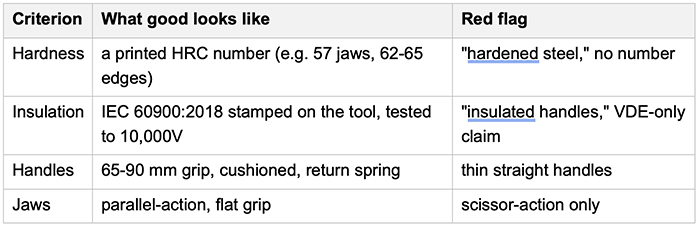
Every one of these is checkable before you buy, if the maker publishes it.
Look for a stated Rockwell hardness number: around HRC 57 on the gripping jaws and HRC 62 to 65 on cutting edges. Below about HRC 55 the edges go blunt quickly on hard wire; above 65 the steel turns brittle and chips. If a brand prints the number, you can compare it. One that only says “hardened steel” is asking you to guess.
If anyone on the crew works on live circuits, the tools must be certified to IEC 60900:2018: each one tested to 10,000 volts and rated for work up to 1,000 volts AC. A plastic-dipped handle is not the same thing. Check for the double-triangle 1000V mark stamped on the tool itself, and note that VDE is a testing house, not a standard, so a non-VDE tool is fine as long as it carries IEC 60900:2018.
A handle that fits the hand cuts fatigue and injuries over a shift. A study of assembly pliers found that grip span and handle padding change how hard the forearm muscles have to work (source). Look for a grip that opens to about 65 to 90 mm in use, a cushioned handle, and a return spring on tools used for repeated cuts so the jaws open on their own. NIOSH publishes a plain checklist for choosing hand tools (source).
Most pliers pivot on a single point, so they close like scissors and the grip lands at the tip. That is fine on a fat cable, but on a nut or a connector the tip digs in at one spot and can round or crush it. Parallel-action jaws stay flat as they close and grip along the whole length, so they hold a fitting square instead of rounding it. That flat grip matters most on heavy daily work, where a rounded fitting can turn a quick job into a repair.
Maun Industries is one maker that clears every check and publishes its numbers. A Nottinghamshire firm that has built pliers since 1944, it states hardness at HRC 57 on the jaws and up to 62 to 65 on the cutting edges, builds its range on parallel-action jaws, and certifies its insulated tools to IEC 60900:2018.
The catch is cost and range. A specialist set runs more than a parts-store pair, and the firm builds pliers and cutters rather than a full tool line, so the rest of the kit comes from elsewhere. For the pliers themselves, the published numbers let a crew reorder year after year and get the same tool each time.
No single brand wins every line. For electricians who want the lightest VDE-rated cutters in the hand, the German makers like Knipex and Wiha are often the more comfortable pick. If you want one supplier across every tool type and one warranty contact, a full-line brand like Klein or Channellock saves you purchase orders. These checks matter most where a tool gets daily, heavy use; for a kit that sees only the occasional light job, a mid-range set is fine.
What company makes the best pliers? There is no single winner. The makers that publish their hardness, insulation, and handle data (Knipex, Klein, Wiha, NWS, and the specialists) are the ones you can hold to a standard. “Best” is whichever meets your spec for the job and the duty cycle.
Is Klein or Knipex better? They are strong at different things. Klein is built around US electrical work; Knipex is known for cutting performance and comfortable VDE ranges. Many shops carry both and pick by task.
What is the most versatile type of pliers? For maintenance, combination (lineman’s) pliers and tongue-and-groove (water-pump) pliers cover the most ground, with a long-nose pair for reaching connectors and fasteners in tight spots.
What are the best pliers for mechanics? Diagonal cutters, long-nose, and hose-clamp pliers see the most use in a bay. Prioritize cutting-edge hardness and a comfortable handle for repeated cuts; those two outlast everything else in a working bay.
Treat pliers like any other consumable that affects uptime. Confirm the hardness, the insulation rating, the handle, and the jaw type, buy one of each shortlisted brand, and run them for a month on real jobs. Standardize on whatever is still working at the end of it.

Forging the Next 250 Years: Powering the Next Era of American Manufacturing
As manufacturers offer more customization than ever before, managing product complexity has become a critical challenge. Tune in with Dan Joe Barry, Vice President of Product Marketing at Configit, who explores how companies are tackling the growing number of product configurations across engineering, sales, manufacturing, and service. He explains how Configuration Lifecycle Management (CLM) helps organizations maintain a single source of truth for configuration data. The result: fewer errors, faster quoting, and the ability to deliver customized products at scale.
Get In Touch
Google news and SEO compliant, Industry Today’s state-of-the-art digital media platform offers bespoke media campaigns that target key decision makers and buyers to achieve your marketing and promotional goals.

Contribute
Showcase your brand and promote your business to our highly targeted audience. We offer detailed Google Analytics with measurable ROI to assure success. Submit your content for review by our Editorial team who will contact you to discuss the project further.
About Us
Reach Your Targeted Audience and Grow Your Business. Learn more About Industry Today.
Contact Us

© 2026 Industry today. All Rights reserved.