by Harry Moser, Founder/President, Reshoring Initiative®
A global transformation is underway due to the simultaneous intersection of major forces reshaping the workforce and where and how work gets done. A demographic shift is in progress due to an aging population, accelerating retirements, declining birth rates, and changing immigration trends. At this time of new technology implementation, supply chains are restructuring and reshoring due to geopolitics and uncertainty, and a massive critical skills shortage is emerging.
The great convergence is ushering in a workforce-centric economic paradigm shift, where human talent, and technology together are the primary engines for productivity, competitiveness, reshoring, and manufacturing and economic growth.
The Baby Boomer workforce exit is triggering a massive loss of specialized expertise and institutional knowledge, initiating a serious labor shortage. This giant wave of retirements or “Silver Tsunami,” is expected to leave up to 1.9 million jobs unfilled over the next decade even before the increased demands of continued reshoring.
Concurrently, global manufacturers are rapidly deploying automation and new technologies to resolve labor shortages and boost competitiveness, displacing lower-level repetitive jobs but at the same time generating an exceptionally high and urgent demand for new, higher-skilled roles.
Meanwhile, companies are restructuring supply chains and reshoring in an effort to mitigate geopolitical and tariff uncertainty.
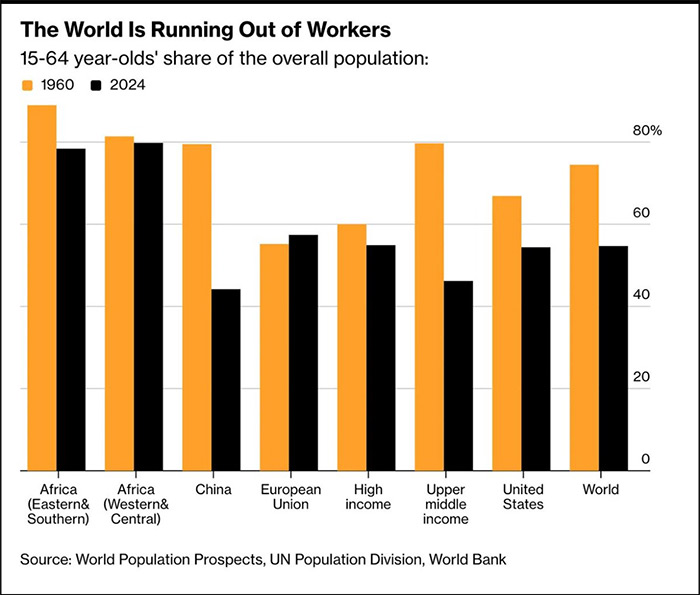
Competition for skilled workers is the new normal. Labor markets across the world are on the verge of a profound demographic transformation as the baby boomer cohort (born 1946-1964) retires, taking decades of accumulated institutional knowledge and leadership experience with them. Figure 1.
About 26% (3.9 million) of the U.S. manufacturing workforce is eligible for retirement (55+ years) resulting in an intellectual knowledge transfer and technological skills gap at a never before seen generational scale. Figure 2.
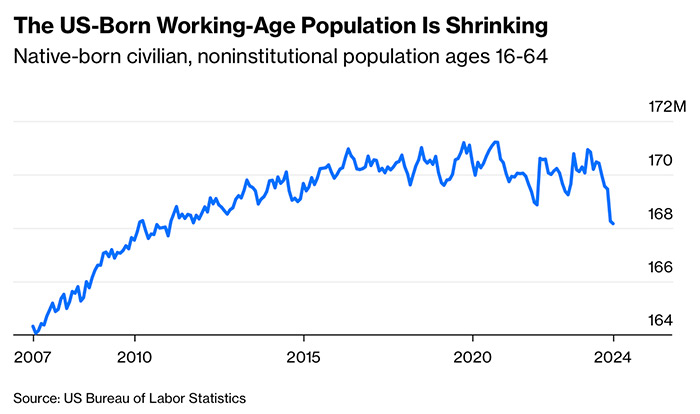
Economists are also concerned about labor shortages from population declines from immigration measures that are causing one of the most significant slowdowns in U.S. population growth in decades. Just a temporary immigration slowdown could leave the U.S. with 4.6 million fewer people of working age by 2033. Figure 3.
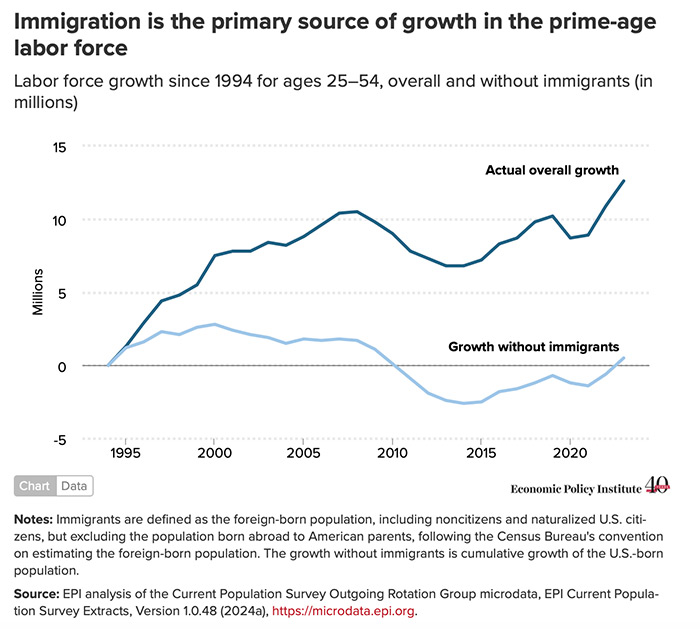
On the brighter side, the U.S. has better demographics than most countries, much better than China. The U.S. workforce has historically remained resilient against population slowdowns due to high workforce participation of prime-age workers, immigration dynamics, and productivity growth. In addition, there are steps we can take to stabilize the workforce.
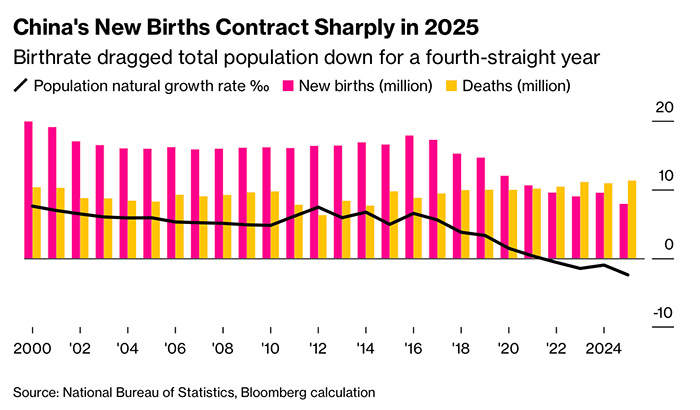
China is facing a demographic crisis with a population that is shrinking at a pace not seen in decades. The working-age population fell to 60.6% (2025) of the total population, down from 70% about a decade ago. China’s labor crunch has made automation part of its national strategy to compensate for its shrinking workforce.
Even with the abolishment of the one-child policy in 2016, the government is struggling to reverse the downward population trends. High living costs, economic uncertainty, slow income growth and delayed marriages, coupled with dwindling birth rates and an aging society create a dual demographic workforce crisis for China. Figure 4.
Building the U.S. manufacturing workforce of the future requires a 180 degree shift in strategy. The situation requires capturing exiting institutional knowledge while redesigning roles for a hybrid workforce. “The Paradox of Automation: the more efficient the Automated system, the more crucial the contribution of the human operators of that system.” Let’s dig in.
Demographic decline affects multiple systems at once including labor supply, productivity and consumer demand to name a few. The bottom line is most likely slower growth, older societies, more automation, a tighter labor market in critical sectors, a higher demand for skilled workers with greater competition for immigrants, and a rising importance of productivity.
Countries that adapt best will likely combine several stabilizing strategies simultaneously such as; increase productivity through new technology solutions faster than the population declines, sustain immigration, emphasize career pathways that fill critical workforce gaps, and stabilize expenses for family formation, e.g. affordable housing, childcare and education costs.
Companies should implement into their business plans formal knowledge-transfer programs that include mentorships, structured exit interviews, job shadowing, video capture of critical processes and searchable digital knowledge systems.
Digital tools like AI, extended reality (XR) including, virtual reality (VR), augmented reality (AR), and mixed reality (MR), and digital knowledge systems can help manufacturers retain the institutional knowledge and expertise of retiring workers while accelerating workforce training. A PwC study found that VR learners were more focused during training and up to 275% more confident applying what they learned.
Experts recommend organizations focus on several priority actions to build a workforce that can thrive alongside new technologies. Skilled talent shortages and workforce transformation are among the most significant barriers to reshoring and manufacturing growth.
The choice of where to manufacture is no longer based on cheap labor or price alone but rather on a TCO comparison followed by investment considerations in automated production systems to narrow or close the cost gap. Start by doing the math correctly using our free online Total Cost of Ownership Estimator® (TCO).
Upgrading to a future-focused factory, may make more economic sense than offshoring to a low-cost country. Businesses should recruit, train, and upskill the workforce and automate where possible.
Begin by identifying system constraints that limit output, across the operation. Then consider targeted technology that improves throughput at the bottleneck while maintaining a balanced flow across the entire operation.
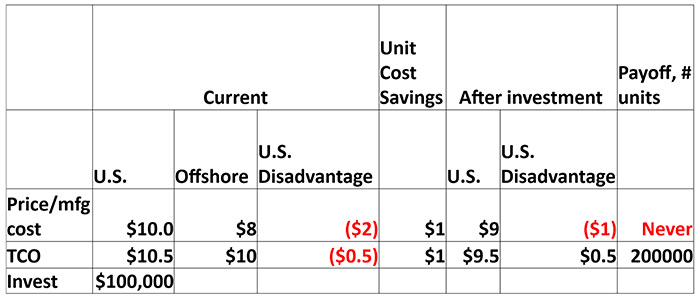
Automation’s biggest impact is on labor but the U.S. vs. offshore comparison includes not just labor, but also burden and material. In a case where the offshore FOB price is 20% lower, a 2-year payback on automation is very unlikely based on price.
But calculating in TCO, based on a TCO difference of just 5%, the U.S. has a much better chance for a fast payback on automation. Integrating automation into a reshoring project can help companies bridge or completely close the cost gap between offshore and domestic operations. See Figure 5.
The FoF production setup is redesigned to mitigate multiple underlying root cost drivers at the same time. Automation reduces labor shortages and costs while enabling more stability thereby reducing waste. Planning and coordination of machines, software, AI, and workers into a synchronized system, also called orchestration, can unlock strong productivity gains of up to 60%.
BCG presented an example of a US pharmaceutical company in tablet and capsule manufacturing. The FoF used digital process control, IoT, advanced analytics, real-time quality control, and accelerated batch release to reduce labor by 60% and lower conversion costs by 30%. Figure 6 shows 3 composite examples.
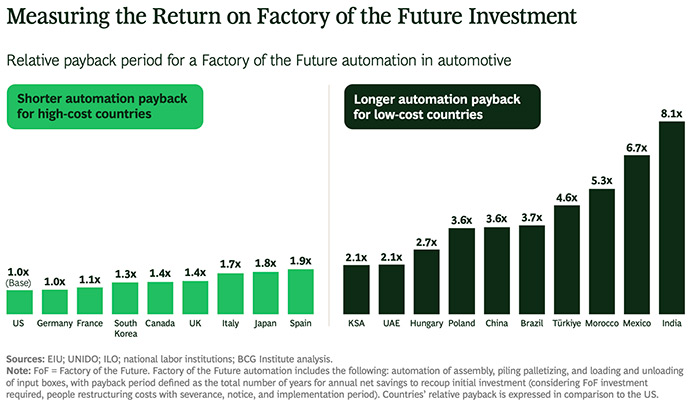
The FoF setup can sometimes reverse the cost gap between manufacturing in high-cost and low-cost countries. A BCG quantitative analysis and a global survey of 1,000 manufacturers found that in some sectors, FoF investments in a high-cost country can have a much faster payback than in a low-cost country and can be more competitive than offshoring, even if lower-cost countries also upgrade their systems.
The impact depends on the sector and on local cost factors like energy, labor, and materials. The impact is shown in high-cost regions when automating labor-intensive tasks, optimizing energy consumption and improving yields. See Figure 7 for an example of how similar FoF deployments in lower-cost markets can sometimes require longer payback periods. A comprehensive use of TCO would further refine BCG’s analysis.

Click here to access the full list of Reshoring Resources offered by the Reshoring Initiative. For help, contact me at 847-867-1144 or email me at harry.moser@reshorenow.org.

Forging the Next 250 Years: Powering the Next Era of American Manufacturing
As manufacturers offer more customization than ever before, managing product complexity has become a critical challenge. Tune in with Dan Joe Barry, Vice President of Product Marketing at Configit, who explores how companies are tackling the growing number of product configurations across engineering, sales, manufacturing, and service. He explains how Configuration Lifecycle Management (CLM) helps organizations maintain a single source of truth for configuration data. The result: fewer errors, faster quoting, and the ability to deliver customized products at scale.
Get In Touch
Google news and SEO compliant, Industry Today’s state-of-the-art digital media platform offers bespoke media campaigns that target key decision makers and buyers to achieve your marketing and promotional goals.

Contribute
Showcase your brand and promote your business to our highly targeted audience. We offer detailed Google Analytics with measurable ROI to assure success. Submit your content for review by our Editorial team who will contact you to discuss the project further.
About Us
Reach Your Targeted Audience and Grow Your Business. Learn more About Industry Today.
Contact Us

© 2026 Industry today. All Rights reserved.