by Harry Moser, Founder/President, Reshoring Initiative®
The manufacturing climate strengthened significantly between the 2025 and the 2026 USA Reshoring Survey periods. The growth was significantly driven by increased reshoring in the semiconductor, pharmaceutical and defense industries and growing demand for the materials and power required to support data centers.
But bringing back large-scale manufacturing alone won’t be enough to win back the American factory floor. We must also rebuild the middle; the ecosystem of small and medium-sized manufacturers (SMMs) that support the large Original Equipment Manufacturers (OEMs). Despite being only a tiny fraction of total firms, large enterprises (500 or more employees) account for 59.1% of all manufacturing sector employment. Small and medium-sized firms (<500 employees) employ the remaining ~40.9% (with small manufacturers employing roughly 4.8 million workers).
To compete globally the U.S. needs the right processes, skilled teams and supporting operational systems to ensure investments translate into sustained productivity improvements. That includes targeted training, new technology adoption, and creating clear career pathways for the specialized engineers and skilled technicians who will drive productivity gains and close critical labor gaps. To put it simply, collaboration across entire ecosystems of production including: supplier networks, talent, and capital, all working together.
So, are we ready to win? Let’s first take a look at the tailwinds.
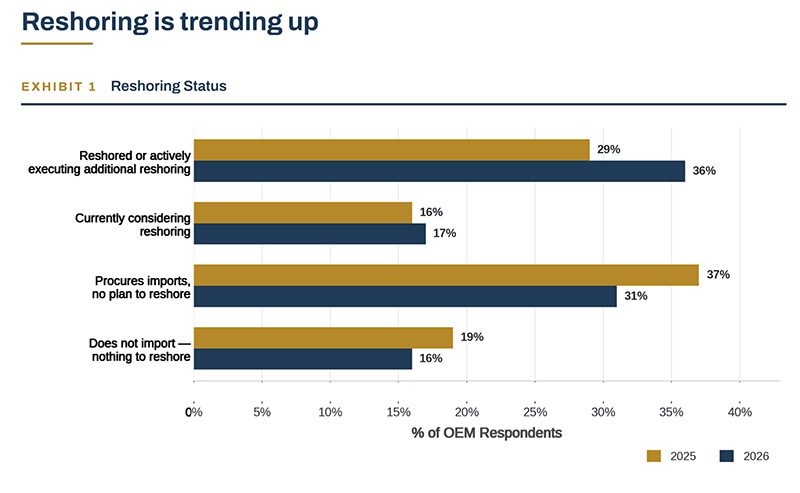
The 2026 USA Reshoring Survey, conducted annually by the Reshoring Initiative® and Regions Recruiting®, finds that U.S. reshoring is trending upward. More OEMs report having reshored or being actively engaged in reshoring in 2026 than in 2025. See Exhibit 1.
Domestic sourcing’s improved speed to market and on-time delivery had the highest actual operational impact ratings. The speed of local production is a great advantage given the AI, automation and same day delivery trends.
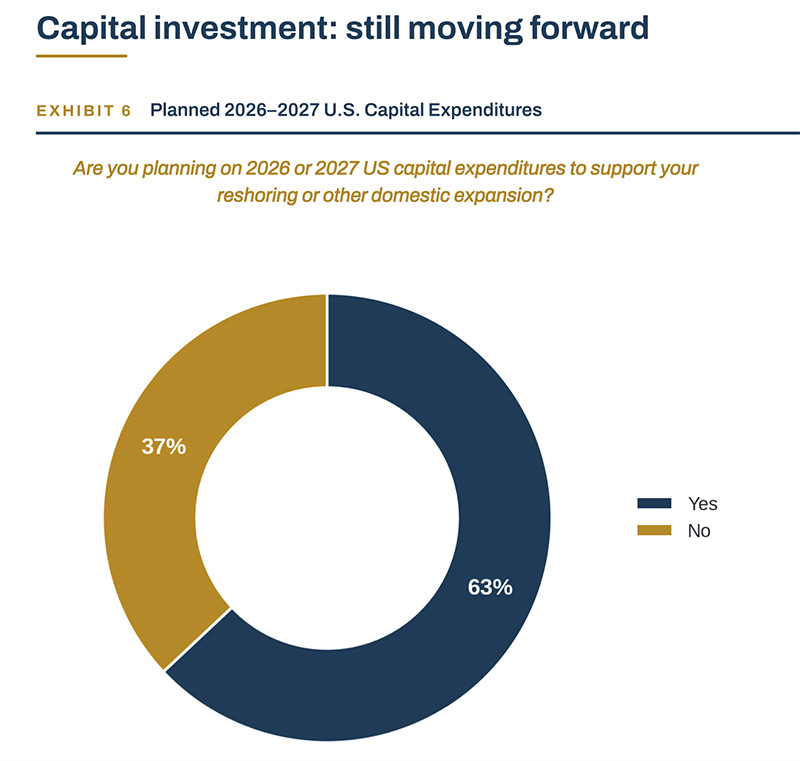
U.S. capital investments are on the horizon through 2027. Roughly two-thirds of OEM respondents across both the “considering reshoring” and “not yet reshored” cohorts said they are planning 2026 or 2027 U.S. capital expenditures to support reshoring or domestic expansion — a meaningfully positive signal given their concerns about uncertainty reported elsewhere in the survey. See Exhibit 6.
Contract Manufacturers (CMs) have more reshoring work in the pipeline. The share of CMs currently quoting reshoring projects roughly doubled year over year (16%→32%) — a strong forward indicator even though completed/active reshoring pulled back from last year.
Among OEMs that reshored since January 1, 2025, the top reasons cited were tariffs, geopolitical risks, and delivery times/proximity to customers. In 2026, geopolitical risk is the #1 driver for CMs and #2 for OEMs, higher for both than in 2025.
This is a useful reframe for CM sales conversations: lead with tariff/risk exposure, then win the business with quality, delivery, and Made-in-USA.
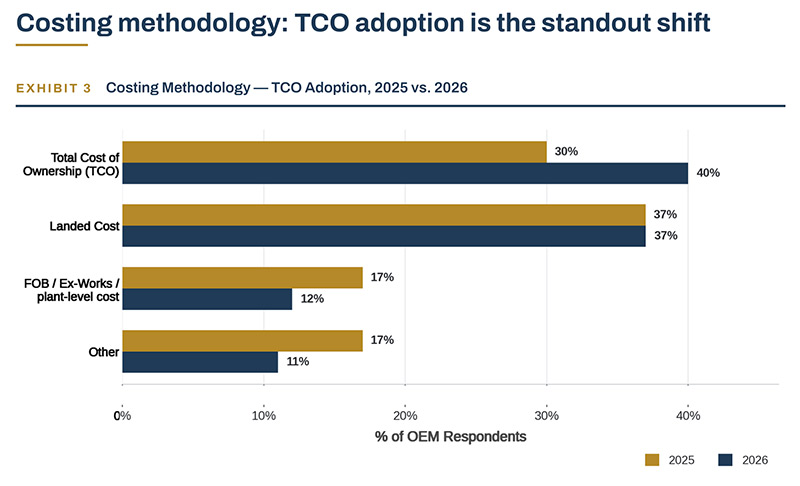
TCO adoption is rising. 40% of OEMs now use Total Cost of Ownership to compare offshore vs. domestic options, up from 30% in 2025 — the clearest, most direct win for the Reshoring Initiative’s core message regarding “apples to apples” cost comparisons. The 60% still not using it is an opportunity for additional reshoring. See Exhibit 3.
The survey shows that reshoring interest and investment are there, but companies need greater predictability to commit capital and develop supply chains for the long term. Manufacturers can adjust to known costs and opportunities. What is much harder to manage is a moving target.
This is the clearest single finding in the policy section of the survey: manufacturers are not primarily asking for a specific tariff level — they are asking for stability they can plan around.
Skilled workforce remains the binding constraint on how much reshoring can happen. One of the top triggers for increased reshoring was having an abundant, highly skilled workforce available in the U.S. Given that resource, OEMs would reshore 30% of their products currently offshored.
Employers report the most acute hiring difficulty is skilled trades (technicians, maintenance/repair) and lean most heavily on internal upskilling and trade/vocational schools to fill roles. Overcoming barriers will require coordinated action from manufacturers, policymakers, and the broader industrial value chain.
The survey found satisfaction in reshoring remains net positive, but the swing is significant: 65% of OEMs report being satisfied with reshoring results in 2026, down from 96% in 2025, with dissatisfaction rising to 25% from just 4%. This does not suggest reshoring itself is failing because the operational impact data (see Exhibit 4) still shows the positives outweighing negatives 2-to-1.
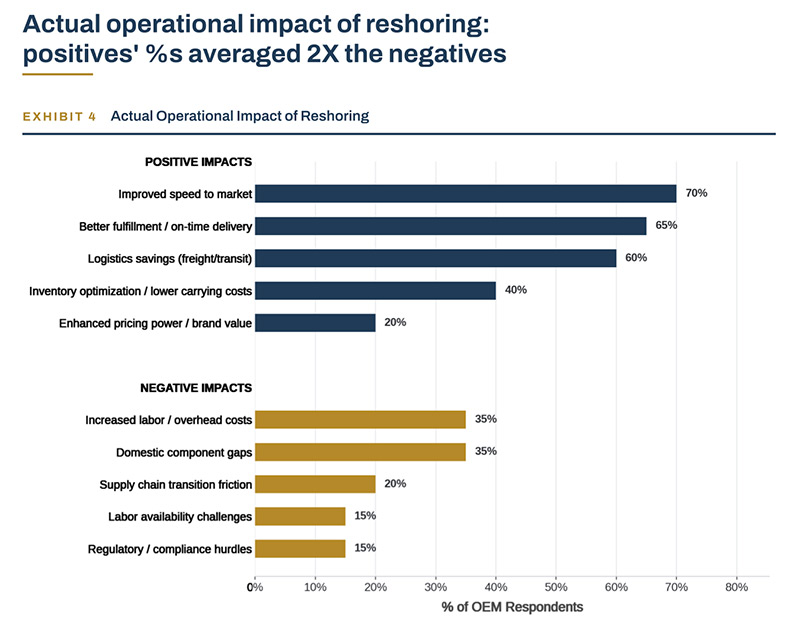
It does suggest, however, that first-year results are running into challenges: labor costs, vendor gaps, inflation, and general implementation and adjustment pains. Policy uncertainty, import price competition and shortages of skilled workers are creating real constraints on reshoring’s pace and scale. These headwinds are delaying broader adoption.
Rebuilding America’s industrial edge requires revitalizing the innovation and research, skilled workforce pipeline, financial support, tech providers, trade associations and logistics organizations that create resilient supply chains. It will require investment in automation, training, education, and changing perceptions of the industry as a whole to develop a workforce with suitable, contemporary skills. It will also require federal policies that level the cost playing field.
To make a quantifiable impact, capital must be deployed strategically. The bottlenecks must be identified and addressed. Is there limited supplier capacity, vulnerable inputs, skilled worker shortages, insufficient inspection capacity, certification processes that must be met, shortages of critical materials or inadequate logistics infrastructure or capital investment. Is there poor coordination and integration across suppliers that prevent scaling production effectively?
Manufacturing transformation requires organizational changes to coincide with carefully planned investments. Rebuilding resilient supply chains and ecosystems matters as much as adding factories. Filling a domestic supply-chain gap can unlock additional reshoring both upstream and downstream.
A successful U.S. manufacturing ecosystem benefits from strong domestic suppliers. Expanding domestic production of critical components and materials can strengthen resilience and support long-term growth. Success depends on reliable access to inputs at competitive costs.
Manufacturing competitiveness increasingly depends on adaptability. Flexibility and responsiveness are becoming as important, if not more important than cost. Reshoring can be critical to operational resilience. Reshoring improves reliability by reducing transportation disruptions, offering greater control over quality and delivery schedules, less geopolitical risk and faster response to demand changes.
New technologies that overcome labor shortages and offset higher U.S. wages will help to close the cost gap and reshore more manufacturing to America. U.S. wages are two to five times as high as in the countries the United States reshores the most from, so, to be globally competitive, America needs to update, modernize and automate as it is reshoring.
Balancing our trade deficit with most countries will increase our manufacturing output and investment faster, providing the needed critical mass and productivity increases. Increasing our manufacturing broadly and quickly will eliminate supply chain gaps, reducing our dependence on China.
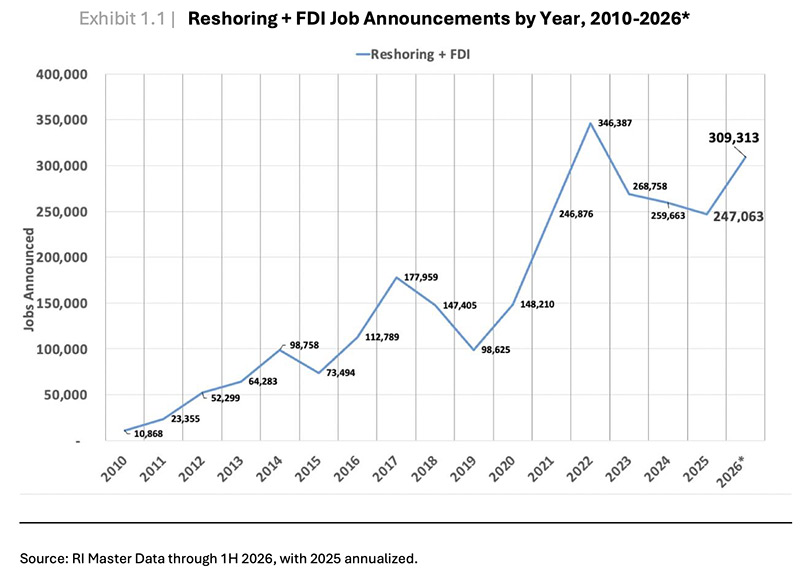
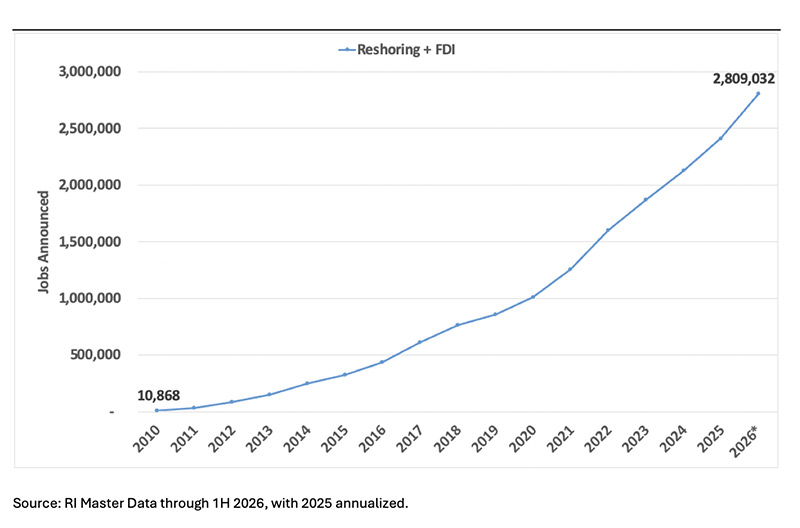
Early Reshoring Initiative 2026 data point toward another strong year of manufacturing investment. Based on 2026 first-half-year announcements, the Reshoring Initiative projects approximately 309,000 jobs for the year — about 25% more than in 2025 — and cumulative announcements since 2010 of approximately 2.8 million. See figure 1 and figure 2. A further surge in July, August and September suggests the 2026 total could reach 400,000.
Of the 64 conditional reshoring and FDI announcements identified during 2025, 14 have already converted either partially or fully into confirmed manufacturing projects. If manufacturers continue to gain confidence in the long-term policy environment, another significant wave of reshoring and FDI investment seems likely.

Click here [https://reshorenow.org/resources/] to access the full list of Reshoring Resources offered by the Reshoring Initiative. For help, contact me at 847-867-1144 or email me at harry.moser@reshorenow.org.
The Ninth National Metalworking Reshoring Award will recognize the top case of reshoring in products, parts or tooling made primarily by metal forming, fabricating or machining, including additive machining. Apply for the 2027 National Metalworking Reshoring Award today!

Forging the Next 250 Years: Powering the Next Era of American Manufacturing
Brooklyn Army Terminal (BAT) began as a World War II-era military supply base. Today it is New York City’s largest publicly owned industrial campus, with 59 waterfront acres, more than 4 million square feet and over 100 businesses. In this episode of Industry Insights, Bridget Chansakul, Vice President of Leasing & Portfolio Management at NYCEDC, explains what space is available and what’s planned for the 250,000+ square feet of new industrial space in Building A. She also covers how the ferry, parking and on-site childcare help tenants hire and keep workers, along with workforce partnerships, City incentives for manufacturers and where BAT is headed next.
Get In Touch
Google news and SEO compliant, Industry Today’s state-of-the-art digital media platform offers bespoke media campaigns that target key decision makers and buyers to achieve your marketing and promotional goals.

Contribute
Showcase your brand and promote your business to our highly targeted audience. We offer detailed Google Analytics with measurable ROI to assure success. Submit your content for review by our Editorial team who will contact you to discuss the project further.
About Us
Reach Your Targeted Audience and Grow Your Business. Learn more About Industry Today.
Contact Us

© 2026 Industry today. All Rights reserved.