Deepfakes and synthetic identities are redefining fraud, forcing a rethink of how digital trust is verified.
By Travis M. McGregor, CEO, SLC Digital
For years, organizations approached digital fraud as a cybersecurity problem that could be solved with more software layers, more alerts, and more authentication prompts.
Add another verification step. Deploy another fraud detection tool. Increase behavioral monitoring. Require yet another one-time passcode.
That approach worked reasonably well when most attacks were manual, fragmented, and operated at human speed.
But the rise of AI-driven fraud has fundamentally changed the threat landscape.
Today’s attackers can automate impersonation at scale. Deepfake voice technology can convincingly mimic executives during financial approvals. Synthetic identities can bypass onboarding systems. Social engineering campaigns can now be personalized, multilingual, and AI-assisted in real time.
The result is that many of the systems organizations still rely on to verify identity are becoming increasingly unreliable.
This is no longer simply a fraud prevention issue. It is becoming an infrastructure problem.
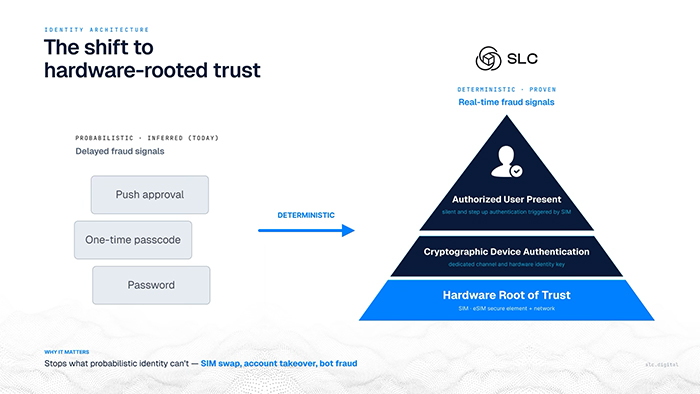
Most digital authentication systems today are built on probability.
A password matches. A push notification is approved. A device appears familiar. A biometric scan reaches a confidence threshold. Individually, these signals increase confidence that a user is legitimate.
But none of them actually prove identity.
That distinction matters far more in an environment where AI can replicate voices, behaviors, writing styles, and even facial movements with increasing accuracy.
Many existing authentication systems were designed around convenience and user experience, not adversarial AI. As a result, organizations are now seeing attackers exploit the assumptions behind these systems rather than attempting to break encryption itself.
SIM-swapping attacks allow criminals to intercept SMS authentication codes. MFA fatigue attacks bombard users with approval requests until one is accepted. AI-generated voice cloning can manipulate call center agents into bypassing identity checks.
Even organizations with multi-factor authentication enabled are still experiencing account takeover and fraudulent approvals because the underlying trust model itself is weakening.
The core issue is simple: most systems are still attempting to infer trust instead of cryptographically proving it. In practice, organizations are increasingly discovering that high-confidence authentication is not the same as high-assurance identity. As AI becomes more effective at mimicking legitimate users, the distinction between probabilistic trust and deterministic proof becomes increasingly important.
Artificial intelligence has accelerated both the scale and sophistication of digital fraud.
Attackers no longer need advanced technical capabilities to launch convincing impersonation attacks. AI tools can automate phishing campaigns, generate realistic synthetic identities, and create deepfake audio or video in minutes.
At the same time, organizations are rapidly adopting AI agents internally to automate workflows, financial operations, customer interactions, and approvals.
This introduces an entirely new challenge.
If autonomous AI systems can execute transactions or approvals on behalf of users, organizations must verify not only who initiated an action, but whether that AI system was explicitly authorized to perform it.
Traditional authentication methods are poorly suited for this environment because they rely heavily on communication channels and workflows that attackers can manipulate.
In the AI era, trust can no longer depend solely on passwords, messages, or app approvals.
It must be anchored somewhere attackers cannot easily replicate.
The next evolution of digital identity is shifting away from probabilistic authentication and toward deterministic verification rooted in infrastructure.
Rather than asking whether a login “looks legitimate,” deterministic identity systems rely on cryptographic proof tied directly to trusted hardware and network infrastructure.
In practical terms, this means authentication is no longer based primarily on codes or prompts sent through potentially compromised channels. Instead, the system verifies that a trusted physical device cryptographically linked to the user is present at the exact moment a sensitive action occurs.
This approach fundamentally changes the economics of fraud.
An attacker may be able to steal credentials, compromise an email account, or manipulate a user into approving a request. But reproducing hardware-rooted cryptographic identity is significantly more difficult because it requires possession of the trusted device itself.
One of the strongest trust anchors already exists inside billions of mobile devices worldwide: the SIM and eSIM.
For decades, SIM technology has securely authenticated devices directly with carrier networks using embedded cryptographic keys. Without that authentication, the device cannot connect to the network.
That same infrastructure can now be extended beyond telecom into digital identity verification.
By leveraging SIM-based authentication, organizations can establish cryptographic proof that the verified device, and the authorized user behind it, is physically present during a sensitive transaction or approval process.
Unlike SMS-based authentication, which relies on phone numbers as communication channels, SIM-based identity leverages secure hardware embedded directly within the mobile infrastructure itself.
This creates a significantly stronger security boundary against phishing, impersonation, and account takeover attacks.
The organizations adapting fastest to AI-driven fraud are increasingly treating identity not as a workflow issue, but as a foundational infrastructure layer.
That shift has significant operational implications.
Financial institutions, manufacturers, and other enterprises all face mounting pressure to reduce fraud losses without creating excessive friction for users. At the same time, regulators and customers are demanding stronger protections around identity verification and transaction security.
Organizations that continue relying solely on software-based fraud detection and behavioral analysis may find themselves trapped in an escalating cycle of alerts, false positives, operational costs, and customer frustration.
Infrastructure-rooted identity changes that equation.
When authentication is tied directly to hardware and cryptographic verification, organizations can authorize high-risk actions with far greater confidence while reducing dependence on increasingly vulnerable communication-based authentication methods.
This is especially important as AI agents begin participating more directly in financial systems, approvals, and enterprise workflows.
The future of digital trust will not rely on asking users more questions or layering on additional prompts.
It will rely on establishing cryptographic proof at the infrastructure level.
The cybersecurity industry is approaching a turning point.
For years, organizations layered new security controls on top of systems originally designed for communication rather than authentication. Passwords were combined with codes, codes with push notifications, and alerts with user judgment.
But AI-driven fraud is exposing the limitations of that model.
The next generation of identity systems will move trust closer to the hardware, the network, and the cryptographic infrastructure itself. The future of digital trust will increasingly depend not on confidence scores or behavioral predictions, but on cryptographic proof of authorization.
In the years ahead, the organizations best positioned to combat digital fraud will not be those with the most authentication prompts.
They will be the ones that can establish deterministic, cryptographic proof of identity and authorization at the moment trust matters most.

About the Author:
Travis M. McGregor is the co-founder and CEO of SLC Digital, an identity authentication company focused on preventing account takeover and high-risk digital fraud through SIM-based verification. A telecommunications veteran with more than three decades of experience building mobile and network technologies, McGregor previously founded Telemac Corporation, a pioneer in prepaid mobile services later acquired by TracFone Wireless. His work focuses on strengthening digital trust through hardware-rooted identity infrastructure.

Forging the Next 250 Years: Powering the Next Era of American Manufacturing
As manufacturers offer more customization than ever before, managing product complexity has become a critical challenge. Tune in with Dan Joe Barry, Vice President of Product Marketing at Configit, who explores how companies are tackling the growing number of product configurations across engineering, sales, manufacturing, and service. He explains how Configuration Lifecycle Management (CLM) helps organizations maintain a single source of truth for configuration data. The result: fewer errors, faster quoting, and the ability to deliver customized products at scale.
Get In Touch
Google news and SEO compliant, Industry Today’s state-of-the-art digital media platform offers bespoke media campaigns that target key decision makers and buyers to achieve your marketing and promotional goals.

Contribute
Showcase your brand and promote your business to our highly targeted audience. We offer detailed Google Analytics with measurable ROI to assure success. Submit your content for review by our Editorial team who will contact you to discuss the project further.
About Us
Reach Your Targeted Audience and Grow Your Business. Learn more About Industry Today.
Contact Us

© 2026 Industry today. All Rights reserved.