ET VALVE’s backrest seated wafer butterfly valves feature rigid seat support for reliable operation in water treatment and other suitable applications.
ET VALVE supplies hard-backed-seat wafer butterfly valves under the Wafer Type Backrest Seated Butterfly Valve name. The seat has a rigid supporting core behind the sealing material. This construction helps the seat hold its shape as the disc moves, making it worth considering where seat retention and controlled operating effort matter.
Our backrest seated wafer family covers DN40–DN1200 with PN6, PN10 and PN16 pressure options. Water treatment is one application. Clean water or air service at ordinary operating conditions is another starting point for selection. The actual seat compound and complete valve rating must still match the line.
If your enquiry asks which wafer butterfly valve uses a hard backed seat, specify our backrest seated model rather than a generic “soft seated valve.” Hard backed describes the seat support. It does not mean that the disc closes against a metal seat, and it does not establish suitability for every severe service duty.
Our Wafer Type Backrest Seated Butterfly Valve uses a supported seat arrangement. The backing holds the sealing element in a defined shape within the wafer body. The disc still works against the selected sealing surface.
A useful way to think about it is a seal with a frame. The frame supports the shape; the sealing material handles the contact. Those two jobs are related, but they are not the same.
Rigid backing can help resist distortion of the seat. That is the reason to discuss this design when seat movement or uneven contact is a concern. It is not permission to ignore poor pipe alignment or an unsuitable rubber compound.
The terminology causes avoidable buying mistakes. A resilient sealing face can have rigid support behind it. Calling the complete arrangement “hard backed” does not turn the sealing interface into a metal to metal design.
Ask about both layers. What supports the seat? What material contacts the fluid and disc? The answer to the second question matters when the liquid contains chemicals or when the operating temperature changes.
For a replacement enquiry, the word “backrest” is useful because it identifies our product family. Keep the original valve identification with the enquiry as well. Matching the name alone is not enough to establish spare part interchangeability.
In this design, contact between the seat face and the disc hub forms a primary seal. Contact around the stem bore provides a secondary sealing arrangement. These details help separate the fluid from the body and stem in the intended assembly.
The seat also incorporates a molded O ring feature for flange sealing. Separate flange gaskets are not required for a correctly matched installation. The approved installation arrangement still governs; adding another layer of gasket material should not be treated as an automatic improvement.
All three constructions can appear in a wafer valve enquiry. They should not be treated as interchangeable descriptions of the same product.

Choose on the failure mode you need to address. A hard backed seat deserves attention when retention and shape control are central concerns. A removable soft backed seat may be more attractive when handling a core less spare is important to the maintenance team.
Bonded rubber lining involves a different repair approach. Do not order it as a substitute for a removable seat without discussing what happens when the sealing material eventually needs attention.
There is no useful winner independent of the service conditions. A correctly selected soft backed valve can be a better purchase than an incorrectly selected hard backed one. The more substantial looking seat is not automatically the safer choice.

The following selection data applies to our backrest seated wafer family reviewed for this article. It establishes a starting range, not the final rating of an unspecified assembly.
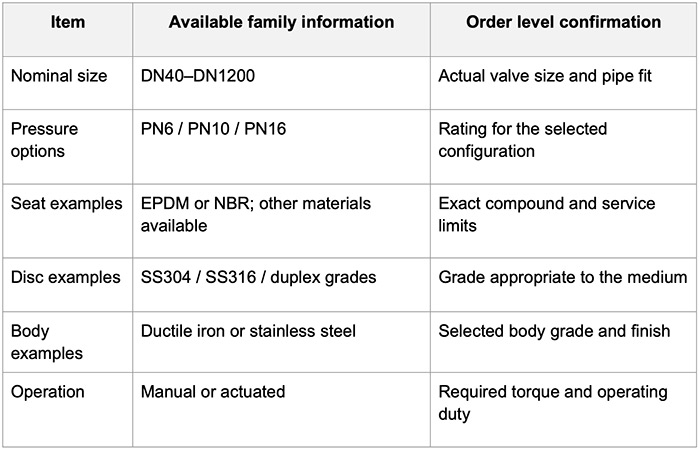
A catalogue may show several temperature ranges across different materials. That does not give one standard seat all of those capabilities. Ask for the temperature limit of the compound in the proposed valve.
Include cleaning temperatures if they differ from normal operation. Also describe the duration of an unusual exposure. A line that usually carries cool water may still impose a different requirement during a maintenance cycle.
The same discipline applies to chemistry. “Stainless disc” is incomplete information when the fluid is corrosive. Identify the grade and check its suitability together with the seat material.
Our family includes flange connection options associated with PN10/PN16 and ANSI Class 150. Connection compatibility and the valve’s allowable working conditions must both be established.
Ask for the dimensional drawing that goes with the proposed valve. Check it against the existing flanges rather than assuming the drilling matches because two quotations use the same nominal size.
Consider a maintenance team investigating a valve that has become difficult to turn. The immediate temptation is to order a larger actuator. That might hide the symptom while leaving the cause untouched.
The right question is why the resistance changed. The inspection may need to address seat condition or deposits around the disc. Flange alignment also deserves attention. Treat this as a diagnostic situation, not proof that every stiff valve needs a hard backed seat.
Our backrest seated design targets stable seating and reduced friction. Those characteristics can help with operating effort, but they do not provide a universal actuator size. Actual torque depends on the selected valve and its service conditions.
We recommend matching the actuator to the proposed assembly instead of selecting it by DN alone. Ask for the applicable valve torque and the basis used for sizing. For pneumatic operation, include the available air supply conditions.
The control task matters too. A valve that moves occasionally for isolation has a different duty from one expected to cycle repeatedly. State the expected operation before accepting an actuator package.
Do not convert the phrase “low torque” into a claimed percentage saving. Without comparable test conditions and numerical results, that would be a guess. The useful purchase document identifies the actuator and explains why it suits this valve.
ET VALVE is a direct supplier of the Wafer Type Backrest Seated Butterfly Valve. Our supported seat construction is the relevant product distinction. For a buyer, that should lead to a configuration enquiry rather than a generic request for the cheapest wafer valve.
Two suppliers may use different names for a supported seat. Ask for a section drawing or a clear construction description so you can establish what is actually being offered.
Keep the required fluid conditions identical across quotations. Compare the identified seat material. Then compare the pressure rating for that same duty. A broader advertised range does not prove that the quoted assembly is more capable.
We would also ask how replacement parts are identified. A seat that can be removed is useful only if the correct spare can be supplied and installed according to the maintenance instructions.
At ET VALVE, shell strength and seat leakage checks form part of production testing. Operating torque verification is included in our quality control workflow. Unique valve identification supports traceability to the relevant records.
Use our factory quality assurance process to agree on the required acceptance evidence. Establish the test basis before production and identify the records needed at delivery. Do not leave “tested” as an undefined word on the purchase order.
A laboratory test result also has limits. It applies to the tested conditions. It cannot promise an unchanged seal after installation in a line with a different temperature or unexpected contamination.
The ET VALVE Wafer Type Backrest Seated Butterfly Valve uses a rigidly supported seat. The backing helps retain its shape while the chosen sealing material provides the sealing interface. It remains distinct from a metal seated butterfly valve.
Our backrest seated construction allows seat replacement. Confirm the correct spare against the valve identification and follow the maintenance procedure. Safe isolation and access are required; replaceability does not mean that work can be carried out under pressure.
Do not assume so. This wafer design is installed between mating flanges. If the duty involves removing downstream pipework while retaining upstream pressure, specify that requirement and obtain an approved valve arrangement for it. Hard backing alone does not establish a dead end service rating.
No. Backing supports the seat mechanically. Chemical suitability depends on the wetted materials and actual fluid conditions. Describe the contamination and temperature before selecting the compound. A structurally stable seat can still be the wrong material.
Specify “ET VALVE Wafer-Type Backrest-Seated Butterfly Valve” and give the required DN. Attach the working conditions with the flange information. State whether operation will be manual or automated.
Ask for an identified seat compound and the corresponding service limits. Include a matching spare seat if replacement is part of your maintenance plan. Request the agreed testing records with delivery.
That is a much better buying basis than “hard-backed valve required.” It connects the seat design to the job it must do and gives the people installing it something concrete to check.

Forging the Next 250 Years: Powering the Next Era of American Manufacturing
As manufacturers offer more customization than ever before, managing product complexity has become a critical challenge. Tune in with Dan Joe Barry, Vice President of Product Marketing at Configit, who explores how companies are tackling the growing number of product configurations across engineering, sales, manufacturing, and service. He explains how Configuration Lifecycle Management (CLM) helps organizations maintain a single source of truth for configuration data. The result: fewer errors, faster quoting, and the ability to deliver customized products at scale.
Get In Touch
Google news and SEO compliant, Industry Today’s state-of-the-art digital media platform offers bespoke media campaigns that target key decision makers and buyers to achieve your marketing and promotional goals.

Contribute
Showcase your brand and promote your business to our highly targeted audience. We offer detailed Google Analytics with measurable ROI to assure success. Submit your content for review by our Editorial team who will contact you to discuss the project further.
About Us
Reach Your Targeted Audience and Grow Your Business. Learn more About Industry Today.
Contact Us

© 2026 Industry today. All Rights reserved.