Metro job growth is reshaping the manufacturing workforce as blue-collar jobs expand in fast-growing Sun Belt and Mountain West labor markets.

By Ted Abernathy, Managing Partner, Economic Leadership
America’s employment map is changing. The metros gaining the most jobs are not growing in just one sector or one type of work. Many are adding professional workers, skilled tradespeople, production employees, transportation workers and service workers at the same time. That matters for manufacturers because where people and jobs are growing can help identify expanding labor pools, but it also shows where competition for skilled workers is likely to intensify.
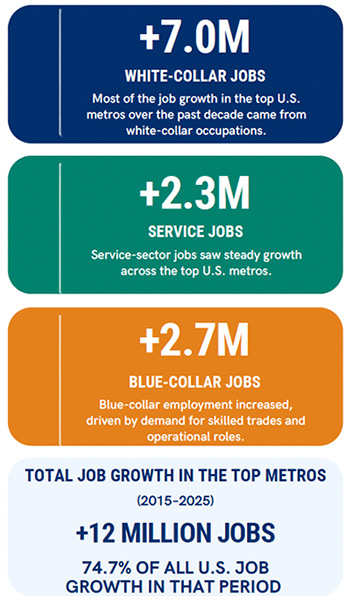
Economic Leadership’s Metro Momentum report examined nearly 800 occupations across the 150 largest U.S. metropolitan areas. Between 2015 and 2025, those metros added more than 12 million jobs, accounting for nearly 75% of all U.S. job growth during the decade.
White-collar occupations accounted for the largest share of the increase, adding about 7 million jobs. But blue-collar employment also grew substantially, adding 2.7 million jobs, while service occupations added another 2.3 million.
The geography of that growth is important. Many of the same Sun Belt and Mountain West metros appear near the top of the rankings across multiple types of employment. The strongest-performing places generally combined population growth, business investment and increasingly diverse employment bases.
For manufacturers, that distinction matters.

For this analysis, blue-collar employment includes manufacturing and production workers along with skilled trades, construction, maintenance, transportation, material-moving and other hands-on occupations.
Over the past decade, blue-collar employment grew fastest in many of the same metros experiencing strong population and business growth. Austin, typically thought of as a technology center, led the 2015–2025 percentage growth rankings with blue-collar job growth of 62.9%, followed by Provo at 54.8%, Boise at 49.8%, Port St. Lucie at 48.4% and Huntsville at 45.5%.
The same pattern holds when we narrow the lens to 2019–2025. Austin’s blue-collar employment increased 33.2% between 2019 and 2025, Huntsville grew 26.7% and Port St. Lucie grew 24.8%. Nine of the nation’s 20 fastest-growing metros for blue-collar jobs during this period were in Florida or Texas.
A fast-growing metro is not automatically a strong manufacturing location. Manufacturers still need to look beyond manufacturing employment alone and understand the broader labor market.
A maintenance technician may have opportunities in manufacturing, utilities, transportation or construction. A truck driver or material-moving worker can move among multiple industries. Engineers and managers are competing in an even broader labor market.
In other words, manufacturers are competing for workers with the entire regional economy.

Fast-growing metros can offer manufacturers a larger and expanding workforce, more business activity and stronger supplier and service networks. At the same time, growth creates competition for many of the same workers manufacturers need.
That makes population trends, housing, infrastructure, commuting patterns and cost of living part of the workforce discussion. Metro Momentum found that many growing destinations also offer lower housing costs, lower taxes or available land compared with higher-cost markets, helping them attract both workers and businesses.
Manufacturing location decisions are being reshaped by forces that extend well beyond labor availability. No one has a crystal ball, but the more accurately we can anticipate change, the better we can plan and act.
Manufacturers recruit from the broader regional labor market. Growth in construction, transportation, logistics, utilities and other industries can expand a regional economy while also increasing competition for many of the same workers manufacturers need.
No. Job growth is one indicator of labor-market momentum. Manufacturers still need to consider the availability of specific occupations and skills, wages, infrastructure, sites, supply chains and other operating requirements.
Population and labor-force trends, occupational growth, competing demand for workers, commuting patterns, housing, cost of living and infrastructure can all affect a company’s ability to attract and retain employees.
Geography has always played a significant role in manufacturing location decisions, from access to natural resources and transportation networks to proximity to supply chains. Today, skilled labor is an increasingly critical factor, and that talent is concentrating in metros that have not always been considered traditional blue-collar centers. Understanding where the deep talent pools of the future are forming will give manufacturers considering expansion or a new location an advantage.

About the Author:
Ted Abernathy is Managing Partner of Economic Leadership, a consultancy focused on economic competitiveness, workforce, strategy and future trends. Over his 44-year career, he has led city, county and regional economic development organizations and an economic policy think tank and is the principal author of nearly 125 reports on economic and workforce development, technology, leadership and future trends. He currently serves as economic advisor to the Council of State Chambers.
Read more from the author:
2026 Outlook: Staying Focused in a Year of Uncertainty | Wake County Economic Development, January 14, 2026
Manufacturing Remains Critical to the State’s Economy | NC Chamber, October 5, 2016

Forging the Next 250 Years: Powering the Next Era of American Manufacturing
As manufacturers offer more customization than ever before, managing product complexity has become a critical challenge. Tune in with Dan Joe Barry, Vice President of Product Marketing at Configit, who explores how companies are tackling the growing number of product configurations across engineering, sales, manufacturing, and service. He explains how Configuration Lifecycle Management (CLM) helps organizations maintain a single source of truth for configuration data. The result: fewer errors, faster quoting, and the ability to deliver customized products at scale.
Get In Touch
Google news and SEO compliant, Industry Today’s state-of-the-art digital media platform offers bespoke media campaigns that target key decision makers and buyers to achieve your marketing and promotional goals.

Contribute
Showcase your brand and promote your business to our highly targeted audience. We offer detailed Google Analytics with measurable ROI to assure success. Submit your content for review by our Editorial team who will contact you to discuss the project further.
About Us
Reach Your Targeted Audience and Grow Your Business. Learn more About Industry Today.
Contact Us

© 2026 Industry today. All Rights reserved.