Manufacturing often gets treated as the last box to check in product development, but that mindset can cost you later.
The process you choose to build a product influences its cost, performance, reliability, sustainability, and how fast it actually reaches customers. Getting it right depends on weighing geometry, materials, order quantity, tolerances, regulatory needs, and real-world use conditions together. Injection molding, for instance, can work well for repeatable plastic components made in higher volumes—though it’s far from a default answer for every project. This article lays out a practical framework for comparing manufacturing approaches before you commit to tooling or lock in final designs.
Before you evaluate any production method, nail down the product requirements: intended function, expected loads, operating temperature, lifespan, dimensional accuracy, surface finish, and any safety or regulatory obligations. Separate the must-haves from the nice-to-haves. Picking a process too early—before these details are documented—tends to invite redesigns, quality headaches, and costs nobody budgeted for.
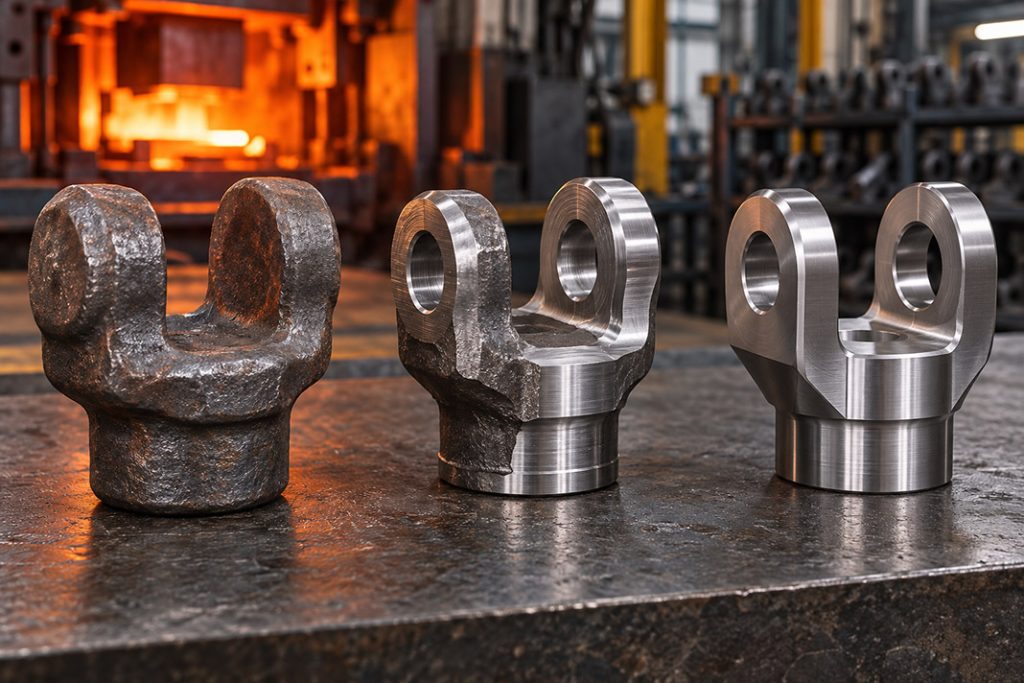
No single method wins across the board. Additive manufacturing is a natural fit for prototypes, custom parts, and complex geometries. CNC machining delivers precision at low-to-medium quantities. Forming processes suit sheet and metal components, while casting handles certain metals, polymers, or intricate shapes. Molding processes shine when you need repeatable components at scale. Each option comes with its own trade-offs—tooling cost, per-unit price, speed, material options, design flexibility, and repeatability all pull in different directions.
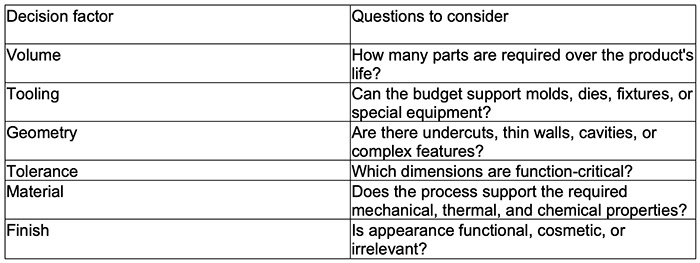
Key Takeaway: The right manufacturing process depends on the complete combination of volume, geometry, material, tolerances, performance, and lifecycle requirements.
A process that works beautifully for a prototype is rarely the right choice for mass production. Think of it as a progression—proof-of-concept prototypes give way to functional engineering prototypes, then pilot batches, then full-scale production. Low-cost prototypes let you catch ergonomic, fit, and usability problems before expensive tooling gets committed. A designer might lean on additive manufacturing to test fit and user interaction, then shift to a repeatable production process once the design has proven itself. Weigh total cost against expected lifetime volume rather than the first order alone—tooling that looks expensive for a small batch can look perfectly reasonable once spread across a larger production run.
A manufacturable design accounts for process limitations from day one. Key variables include wall thickness, draft angles, ribs and bosses, parting lines, undercuts, assembly features, tolerances, and shrinkage or warpage. Tolerances that are tighter than necessary just drive up cost without improving how the product actually performs. Bringing designers, engineers, material specialists, and manufacturers together early helps surface these issues before they turn into expensive problems down the line. Review designs with an eye toward ease of production, inspection, and assembly, as well as material efficiency and future repair needs.
Material behavior during processing can affect dimensional stability and strength, so it’s worth distinguishing cosmetic defects from those that actually compromise safety or function. Technical claims should rest on manufacturer datasheets, recognized standards, or test results—not assumptions.
Material selection should reflect the product’s actual environment and lifecycle, not just broad category assumptions. Compare material properties such as strength, stiffness, impact resistance, heat resistance, chemical resistance, moisture absorption, UV stability, flammability, and biocompatibility where relevant. Verify specific grades and additives instead of relying on vague labels like “plastic” or “metal.” Recycled or bio-based materials can offer real environmental benefits, but they sometimes come with trade-offs in consistency, appearance, or processing behavior. Document the chosen material grade and acceptance criteria so you have something to reference later.
Quality works best when it’s designed into development from the start, not checked for only after production wraps up. A basic framework includes confirming that the design meets documented specifications, validating that the product meets user needs in its intended environment, defining inspection methods and acceptance criteria, and recording design changes and test results. For regulated products, formal design controls may require documented inputs, outputs, reviews, risk analysis, verification, validation, production transfer, and change control. FDA guidance describes design controls as a systematic process for ensuring that medical devices meet user needs and specified requirements.[1][3] Regulatory obligations vary by product category and jurisdiction, so consult qualified professionals wherever safety, medical, electrical, or environmental requirements come into play.
Look beyond material choice to the full lifecycle impact: raw material extraction, manufacturing energy and waste, transportation, use, maintenance, and end-of-life recovery. Strategies that cut environmental impact include minimizing unnecessary material, extending product life, enabling repair, reducing mixed-material construction, and designing efficient packaging. Steer clear of unsupported “green” claims—base sustainability statements on verified lifecycle data, supplier documentation, and recognized standards.
Assess potential suppliers on relevant technical experience, quality-management procedures, material traceability, inspection capabilities, and realistic capacity and lead-time assumptions. Ask for clear explanations of tool ownership, revision control, tolerance capability, defect handling, confidentiality, and minimum order quantities. Compare suppliers on overall suitability rather than price alone.
Selecting a manufacturing process means balancing performance, cost, quality, scalability, sustainability, and risk—no single method is automatically best across every product or volume. Validate your assumptions through prototypes, technical reviews, documented testing, and clearly defined requirements. Before finalizing product geometry, materials, or production tooling, build a requirements-and-process comparison that reflects the product’s full lifecycle.

Forging the Next 250 Years: Powering the Next Era of American Manufacturing
Brooklyn Army Terminal (BAT) began as a World War II-era military supply base. Today it is New York City’s largest publicly owned industrial campus, with 59 waterfront acres, more than 4 million square feet and over 100 businesses. In this episode of Industry Insights, Bridget Chansakul, Vice President of Leasing & Portfolio Management at NYCEDC, explains what space is available and what’s planned for the 250,000+ square feet of new industrial space in Building A. She also covers how the ferry, parking and on-site childcare help tenants hire and keep workers, along with workforce partnerships, City incentives for manufacturers and where BAT is headed next.
Get In Touch
Google news and SEO compliant, Industry Today’s state-of-the-art digital media platform offers bespoke media campaigns that target key decision makers and buyers to achieve your marketing and promotional goals.

Contribute
Showcase your brand and promote your business to our highly targeted audience. We offer detailed Google Analytics with measurable ROI to assure success. Submit your content for review by our Editorial team who will contact you to discuss the project further.
About Us
Reach Your Targeted Audience and Grow Your Business. Learn more About Industry Today.
Contact Us

© 2026 Industry today. All Rights reserved.