A guide to the top five fire alarm monitoring companies and what they do well.
When a fire alarm signal goes unacknowledged for even a few extra minutes, the consequences can be severe. Fire alarm monitoring companies in Orange County vary widely in how fast they respond, how well they handle legacy panel connections, and whether they can keep monitoring active during a power or communication failure. After reviewing dozens of providers across Southern California, the gaps between careful, licensed operators and everyone else became clear. This guide covers five companies worth considering, with honest notes on what each one actually does well.
Publicly available sources drove this ranking: user reviews, service descriptions, ratings from multiple platforms, and official company websites. Every option was cross-checked for a track record that showed real performance in fire protection and monitoring. Options without enough verifiable history in security services were left off the list.
→ See the full research breakdown
The wrong monitoring partner doesn’t just mean slower response times. It can mean false alarms that divert emergency responders from real incidents, fines from the local AHJ, and coverage gaps during a power outage or communication failure.
Facilities with older or proprietary fire alarm control panels face a real challenge. Not every monitoring center can integrate cleanly with legacy systems, and a mismatch there can cause missed signals or delayed dispatch.
Specialized providers who understand these specific pressures tend to perform meaningfully better across the metrics that matter most: alarm acknowledgment time measured in seconds, average emergency dispatch time, and false alarm rate per monitored site. A shorter acknowledgment window and a lower false alarm rate aren’t just numbers. They reflect whether a monitoring partner has actually built their operation around fire safety or is simply offering it alongside a dozen other services.
Note: All data in this table is sourced from review platforms and the official websites of the listed companies.
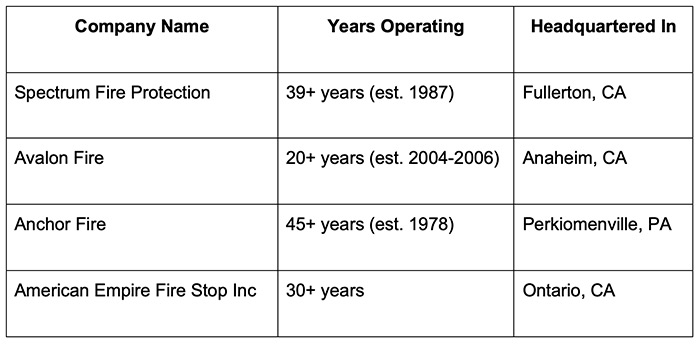

Spectrum Fire Protection is a family-owned commercial fire protection contractor that has operated out of Fullerton, CA, since 1987. They hold all four California licenses required for this work, including their C-16 Fire Protection Contractor license, C-10 Electrical License, and two State Fire Marshal licenses. What makes them genuinely different is their single-contractor model: six service divisions run entirely in-house, covering sprinklers, fire alarms, extinguishers, suppression systems, pumps, and hydrants. Facility managers who want alarm monitoring for commercial fire systems in Orange County backed by that same full-service infrastructure will find very few comparable options locally. This structure can also make ongoing maintenance and compliance easier to manage because multiple fire protection needs can be handled by the same provider. It also helps reduce coordination gaps between inspections, repairs, monitoring, and documentation.
The single-contractor model removes a real operational risk. When one company owns every service division, there’s no finger-pointing between subcontractors when something goes wrong. Their 2-hour emergency response target in Orange County, combined with 39 years of zero disciplinary history under the same license, reflects a level of operational discipline that’s genuinely hard to match.
Spectrum holds a 5.0-star rating across 128 Google reviews, a 4.8 on Yelp, and a 4.9 on Trustindex across 168 reviews. That’s not a single platform anomaly. Consistent responsiveness and documentation quality are the patterns that come up most often across those reviews, which makes sense given their inspection methodology.
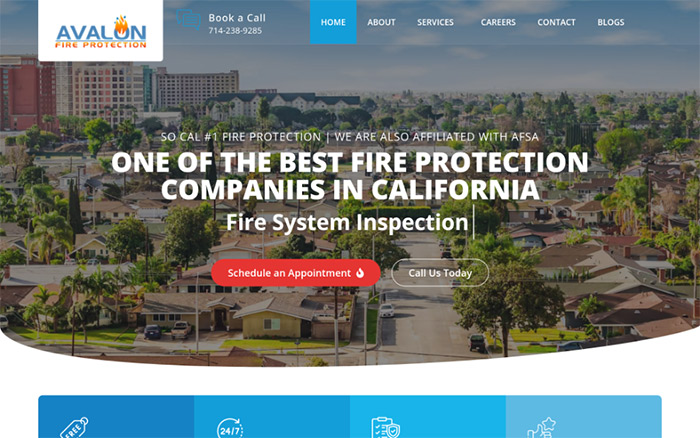
Avalon Fire Protection has been serving Anaheim and the broader Orange County area for around two decades. They cover fire alarm installation and monitoring, sprinkler design and installation, fire extinguisher inspection, suppression systems, and fire pump services. Their pitch is straightforward: fully trained technicians available around the clock, with an emphasis on rapid response and quality work. For a commercial property manager who wants a local provider with solid coverage across fire protection disciplines, Avalon’s service range checks most of the boxes.
Avalon’s strength is regional focus, which tends to translate into faster on-site response times and familiarity with local AHJ requirements across Orange County municipalities. That kind of local operational knowledge is rare in providers who try to cover too wide a geographic footprint.
Publicly available review data for Avalon is limited, which makes it harder to assess patterns across a large sample. What’s available points to a company that prioritizes service quality and responsiveness, though facility managers doing due diligence should request direct references to fill in the gaps.

Anchor Fire Protection has been around since 1978, putting them at over 45 years in this space (not many companies survive that long without doing something right). Headquartered in Pennsylvania, their Los Angeles-based division handles Southern California projects. They run an in-house engineering department, fabrication shop, and inspection department, and they’ve worked on projects ranging from high-rise buildings to large distribution centers. Their scope covers sprinkler systems, fire alarm systems, extinguishers, life safety services, and 24/7 inspection and maintenance across multiple states.
Anchor’s in-house engineering capability sets them apart from contractors who outsource the technical design work. For complex, multi-site, or large-scale facilities where fire alarm system design needs to meet specific life safety codes, that internal department cuts the coordination delays that often slow projects down.
Anchor has earned ABC Eagle Awards for excellence in design and construction in consecutive years, which shows real industry credibility. Detailed consumer review data isn’t widely available publicly, but that award track record alongside 45+ years of operation signals consistency that matters to large commercial clients.

American Empire Fire Stop Inc. brings over 30 years of construction industry experience to a very specific corner of fire protection: firestopping. They specialize in installing and engineering UL-listed fire stop systems for mechanical, electrical, plumbing, low voltage, fire sprinkler, and structural steel penetrations. They also handle acoustical caulking, sealants, pads, and fireproofing. Based in Ontario, CA, their focus on code-approved, UL-listed assemblies makes them a natural fit for general contractors and construction project teams who need fire barrier work done correctly from the start.
Their specialty in UL-listed firestopping fills a gap that many general fire protection contractors leave open, particularly on active construction sites where penetration sealing often gets treated as an afterthought. That level of material specificity usually means tighter code compliance at inspection time.
Public review data for American Empire is limited. Their 30+ years in the field and listing in the Blue Book since 2022 point to a company with established trade relationships and contractor-level credibility (not cheap work, but the kind that passes AHJ inspection). Construction PMs evaluating firestopping subcontractors should reach out directly for references.
Building this shortlist started with a broad sweep of publicly available information across multiple source types.
The initial pool of candidates came from fire protection directories, business review platforms, regional contractor listings, and company websites. Each source was checked for recency and relevance to Orange County and Southern California. Companies were flagged for further review based on their stated service scope, licensing disclosures, and how consistently their name appeared across different sources. The goal at this stage was coverage: casting wide enough to avoid missing strong regional operators that don’t have heavy marketing budgets.
Once the longlist was assembled, options with thin or unverifiable information were removed. This step focused on reviewing patterns across multiple platforms rather than single-source ratings. A company with 200 reviews on one platform and nothing verifiable elsewhere doesn’t tell the same story as one with consistent ratings across Google, Yelp, and industry-specific directories. Licensing status and years of continuous operation under the same credentials were also factored in here, since gaps in either tend to surface in ways that matter when something goes wrong at a facility.
Claims made on company websites were cross-referenced against what appeared in third-party reviews and external mentions. This step checked whether the service descriptions, response time claims, and specialization language held up when tested against what actual clients and industry contacts reported. Companies whose website claims significantly outran their verifiable track record were weighted lower. Real-world results, even imperfect ones, carry more weight than polished marketing copy.
Beyond reviews, each company was evaluated for signals that show its standing within the fire protection and life safety industry. This included award recognition, mentions in trade publications, ABC certifications, UL listing status, State Fire Marshal licensing, and similar markers. A company with ABC Eagle Awards and 45 years of operation under the same business structure signals something different than a newer entrant making equivalent claims. Authority signals like these don’t guarantee quality, but they narrow the risk of a bad pick.
The final filter looked at how clearly each company’s service presence maps to fire alarm monitoring. Dedicated service pages for monitoring, verified client reviews mentioning monitoring response, and documented case studies from commercial facilities were all factored into this layer. Companies where fire alarm monitoring was a named specialty rather than a buried bullet point in a general services list scored higher. This filter is what shaped the “best for” labels: each company on this list has a distinct strength, and the shortlist reflects where each one actually performs rather than what each one claims.
Picking a fire alarm monitoring company comes down to more than price and proximity. The right fit depends on your building type, panel brand, and how much monitoring interruption your facility can realistically afford (which, for most commercial properties, is zero). Here’s what to weigh before signing a contract.
Choosing among fire alarm monitoring companies in Orange County means weighing licensing depth, local knowledge, panel compatibility, and monitoring center reliability all at once. The companies covered here each bring something specific to the table: from Spectrum’s single-contractor accountability and 39-year track record to Intertek’s global certification reach. The fire protection space keeps raising its compliance bar, so working with a provider who already meets the current standard is the right starting point.

Forging the Next 250 Years: Powering the Next Era of American Manufacturing
As manufacturers offer more customization than ever before, managing product complexity has become a critical challenge. Tune in with Dan Joe Barry, Vice President of Product Marketing at Configit, who explores how companies are tackling the growing number of product configurations across engineering, sales, manufacturing, and service. He explains how Configuration Lifecycle Management (CLM) helps organizations maintain a single source of truth for configuration data. The result: fewer errors, faster quoting, and the ability to deliver customized products at scale.
Get In Touch
Google news and SEO compliant, Industry Today’s state-of-the-art digital media platform offers bespoke media campaigns that target key decision makers and buyers to achieve your marketing and promotional goals.

Contribute
Showcase your brand and promote your business to our highly targeted audience. We offer detailed Google Analytics with measurable ROI to assure success. Submit your content for review by our Editorial team who will contact you to discuss the project further.
About Us
Reach Your Targeted Audience and Grow Your Business. Learn more About Industry Today.
Contact Us

© 2026 Industry today. All Rights reserved.