A review of 5 credible Merchant of Record platforms.
Selling software across borders means juggling tax registrations in dozens of countries, wrestling with currency conversions, and keeping up with compliance rules that shift faster than most engineering teams can manage. Merchant of Record platforms for software companies globally fix that by stepping in as the legal seller, collecting payments, remitting taxes, and absorbing chargeback liability so the software company doesn’t have to. The five platforms below are the most credible options on the market right now.
Tax compliance is the quiet cost nobody budgets for. A SaaS company selling into the EU faces VAT obligations across 27 member states; selling into the US means navigating economic nexus rules that vary by state and can change without warning. Building the internal infrastructure to handle all of that takes months and dedicated legal resources that most software startups simply don’t have.
A Merchant of Record (MoR) takes on those obligations entirely. It registers as the seller in each jurisdiction, calculates and collects the correct tax at checkout, files the returns, and remits the funds. Chargebacks land on the MoR, not the software company. The software company keeps its revenue minus fees and skips the compliance overhead altogether.
For globally-minded software teams, that tradeoff is usually worth it from day one.
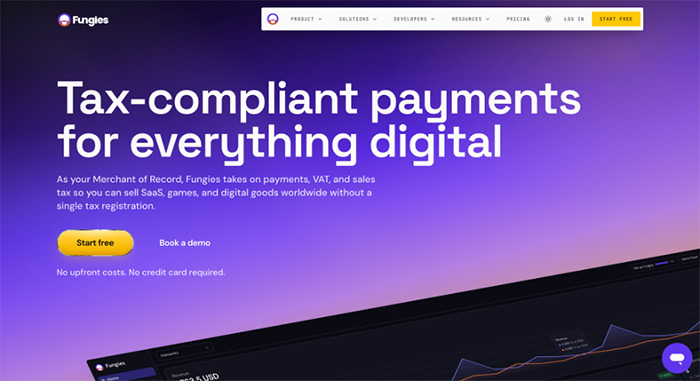
https://fungies.io/ is a Merchant of Record built for SaaS companies and digital product businesses selling across 150-plus countries, with transparent flat-rate pricing and no monthly fees.
Customer feedback points to fast setup, responsive support, and straightforward API integrations as consistent strengths. Customers listed on the platform include Leadsin.io, Freevocals.com, TextToVideo.bot, and RenderAI.app.
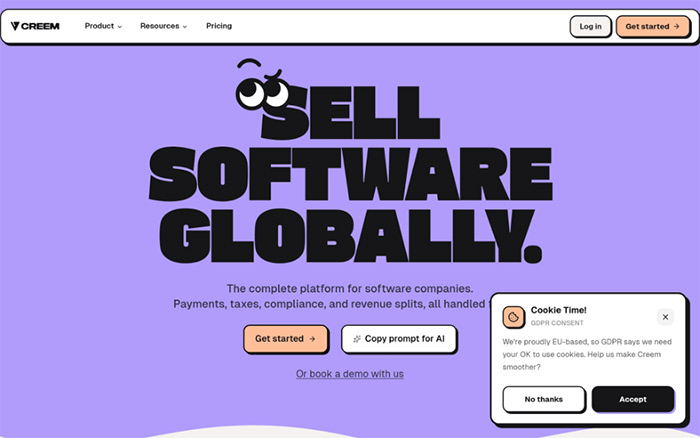
Creem is a lean, two-founder Merchant of Record platform built on fiat and stablecoin rails, particularly suited to software teams that want multi-party payout splitting alongside standard MoR services.
Founded in 2021 and headquartered in Randvere, Estonia, Creem launched its platform in September 2024. The company has raised $2.11M from four investors, including Voi co-founder Johan Pietilä and former Mastercard adviser Martin Olofsson. At the time of reporting, it had reached €930k in annualized revenue.

FastSpring is one of the more established MoR platforms on this list, processing over $1 billion in annual transactions across 200-plus regions for software, SaaS, and digital product businesses.
FastSpring is headquartered in Santa Barbara, California, with offices in Bicester (England), Amsterdam, and Halifax. The parent entity is Bright Market, LLC. The platform handles SaaS, video games, downloadable software, mobile apps, eLearning, and AI monetization, making it one of the broader-scope MoR options available for software companies globally.

Lemon Squeezy is a developer-friendly MoR platform with simple flat-rate pricing and automatic license key generation, now operating under Stripe following its acquisition in July 2024.
Founded in 2020 and headquartered in Salt Lake City, Utah, Lemon Squeezy has 10 employees. Its free entry point and per-transaction model make it accessible for early-stage software companies that aren’t ready to commit to a platform subscription.

Cleverbridge is a high-volume MoR platform with over $10 billion in processed transactions, aimed at established software and SaaS companies that need enterprise-grade subscription management across 240-plus markets.
Founded in 2005 and headquartered in Cologne, Germany, Cleverbridge runs offices in Chicago, Austin, London, and Singapore. The company has earned recognition including an Accel EuroScape Top 100 Most Promising SaaS Company designation. Its depth of subscription tooling and multi-market compliance experience makes it the best fit for software businesses that are already operating at scale.
Not every MoR platform fits every software business. A few things worth evaluating before committing:
Tax coverage. Confirm the platform covers every market the business sells into today and the ones it plans to enter. Some platforms cover 190-plus countries; others top out earlier. Check whether indirect tax handling includes GST (Australia, Canada, India) alongside EU VAT.
Pricing structure. Per-transaction fees are the norm, but the rate and what’s included in that rate varies. Some platforms bundle storefront tools, license key generation, and fraud protection into the base fee; others charge separately for those features or lock them to higher tiers.
Subscription flexibility. Software companies rarely sell just one billing model. Look for support across recurring, usage-based, seat-based, and one-time payment flows, plus the ability to run free trials, handle downgrades, and retry failed payments automatically.
Integration depth. A REST API with webhooks is a minimum bar. Developer teams should also check whether the platform offers CLI tooling, SDKs for their stack, or – for AI-native software companies – MCP integrations that let coding agents configure the payment layer directly.
Support accessibility. Smaller platforms sometimes trade support depth for speed and simplicity. Larger ones offer dedicated account teams but slower response cycles. Match the support model to the business’s actual operational complexity.
Merchant of Record platforms for software companies globally take tax compliance and payment liability off the software company’s plate, that’s the core reason they’re worth choosing over a DIY payment stack. The right platform comes down to company size, geographic scope, and how much flexibility the billing model demands. Early-stage teams tend to get the most out of low-fee, fast-setup options; enterprise software companies often need deeper subscription management and partner network tooling. Each platform above covers a different point on that spectrum, and the facts here reflect what each one actually offers rather than what their marketing implies.

Forging the Next 250 Years: Powering the Next Era of American Manufacturing
Brooklyn Army Terminal (BAT) began as a World War II-era military supply base. Today it is New York City’s largest publicly owned industrial campus, with 59 waterfront acres, more than 4 million square feet and over 100 businesses. In this episode of Industry Insights, Bridget Chansakul, Vice President of Leasing & Portfolio Management at NYCEDC, explains what space is available and what’s planned for the 250,000+ square feet of new industrial space in Building A. She also covers how the ferry, parking and on-site childcare help tenants hire and keep workers, along with workforce partnerships, City incentives for manufacturers and where BAT is headed next.
Get In Touch
Google news and SEO compliant, Industry Today’s state-of-the-art digital media platform offers bespoke media campaigns that target key decision makers and buyers to achieve your marketing and promotional goals.

Contribute
Showcase your brand and promote your business to our highly targeted audience. We offer detailed Google Analytics with measurable ROI to assure success. Submit your content for review by our Editorial team who will contact you to discuss the project further.
About Us
Reach Your Targeted Audience and Grow Your Business. Learn more About Industry Today.
Contact Us

© 2026 Industry today. All Rights reserved.