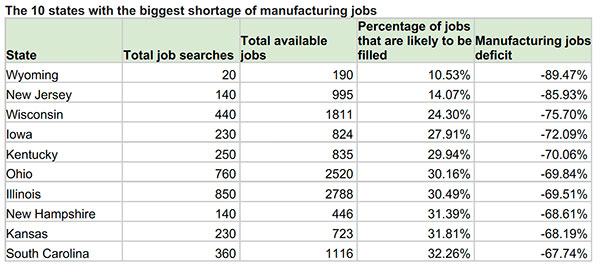
Nearly all states across the US are grappling with a shortage of manufacturing labor, the worst facing a nearly 90% jobs deficit.
Manufacturing software provider, ECI Software Solutions, created the ‘manufacturing jobs deficit index’ to reveal which states across the US are struggling the most to fill vacant roles.
ECI carried out the research off the back of a study by the Manufacturing Institute (MI), finding that by 2030, manufacturers will need to fill an extra four million jobs – over half of which (2.1 million) they predict may go unfilled.
Wyoming had the biggest shortage in demand, with an 89.47% deficit between jobs on the market and worker demand, while on the other side of the country, New Jersey was just behind with an 85.93% deficit.
Businesses in Wisconsin (-75.70%), Iowa (-72.09%), and Kentucky (-70.06%) are also expected to feel the impact of the lack of skilled labor, as the states round out the five states with the biggest deficit.
Only two states, neighbors Louisiana and Texas, have a surplus in labor, with Louisiana’s demand for jobs a staggering 51.57% higher than the opportunities on the market and Texas’ 8.67% greater.
To create the research, the number of LinkedIn vacancies for manufacturing-related roles within each US state was compared with Google Keyword Planner searches for manufacturing-related jobs.
Matt Heerey, President of ECI Software Solutions’ Manufacturing Division said:
“Post-pandemic, the demand for manufacturing workers has increased at such a rate that the labor crisis may be getting worse, with our latest research showing the challenges US businesses face in meeting the demand for skilled workers.
“The extent of the issue varies across the nation, with Wyoming and New Jersey bearing the brunt of the labor shortage, while states like Louisiana and Texas are bucking the trend with a surplus of interest in jobs.
“The industry is actively working towards addressing the shortage nationwide, and manufacturing ERP software can help companies to interconnect their software solutions better, remove bottlenecks and automate manual and operational processes.
“Ultimately, as baby boomers gradually enter retirement, AI and ERP technology can help manufacturers to better plan, forecast and leverage their data better to allocate resources, and understand where they can reduce the need for more headcount, and where they need to upskill.”
For the full manufacturing jobs deficit index, with all 50 states ranked from the highest jobs deficit to the least, please visit: https://ww.ecisolutions.com/blog/manufacturing/manufacturing-jobs-deficit-which-us-states-are-struggling-the-most

Forging the Next 250 Years: Powering the Next Era of American Manufacturing
In this episode of Industry Insights, Ricky Watts, General Manager, Industrial and Robotics Division at Intel Corporation, explains why the Industry 4.0 groundwork manufacturers have been laying for years is now the foundation for AI at scale. He describes how IT and OT systems are finally coming together, and how agentic AI can pull data from the plant floor, the supply chain and the C-suite to find out why a production line is underperforming. Watts also covers why chips have become strategic infrastructure, the rise of physical AI and robotics in harsh industrial settings, and the skills tomorrow’s workforce will need. He finishes with a layered approach to cybersecurity in software-defined plants.
Get In Touch
Google news and SEO compliant, Industry Today’s state-of-the-art digital media platform offers bespoke media campaigns that target key decision makers and buyers to achieve your marketing and promotional goals.

Contribute
Showcase your brand and promote your business to our highly targeted audience. We offer detailed Google Analytics with measurable ROI to assure success. Submit your content for review by our Editorial team who will contact you to discuss the project further.
About Us
Reach Your Targeted Audience and Grow Your Business. Learn more About Industry Today.
Contact Us

© 2026 Industry today. All Rights reserved.