AI adoption is rising in industrial maintenance, but costly downtime persists as workforce gaps and execution challenges hinder reliability.
by Chris Turlica
Because tools alone don’t make a reliable plant. The 2026 State of Industrial Maintenance report, based on responses from 2,234 maintenance and operations leaders across the U.S. and Canada, finds that AI is being adopted faster than any technology that came before it, yet four out of five teams have not seen unplanned downtime improve. The bottleneck isn’t software. It’s execution: retirements leading to fewer people to do the work and institutional knowledge eroding, scheduling discipline, and training the new hires. There’s a distinction the data keeps surfacing: deploying a tool isn’t the same as adopting it. The teams seeing real reliability gains are the ones who have moved from installation to operational discipline. For years, the conversation around industrial maintenance has been about catching up on technology. Get a modern CMMS in place. Roll out condition-based monitoring. Pilot AI. Many teams have done some version of this, and the data shows it. A majority of facilities now use real-time equipment monitoring. Usage-based and condition-based maintenance programs are no longer rare. AI agents, which can monitor operations and take action across systems, are already in use or being tested by 59% of organizations that have deployed AI.
And yet the most basic reliability metric, unplanned downtime, is stuck. 45% of teams report the same amount of unplanned downtime as a year ago. Another 34% report more. That is a striking gap between input and outcome, and it deserves an honest look.
“Reliability gains come from execution maturity, not system adoption alone.”
— 2026 State of Industrial Maintenance Report
The instinct, when downtime won’t budge, is to add another layer of technology. A new sensor. A new dashboard. A new pilot. Some of that is necessary. But the report suggests the binding constraint in 2026 is human, not digital.
The clearest signal in the data is what leaders are not prioritizing. When asked how they plan to reduce downtime in the next twelve months, hiring more technicians ranked fifth on the list, behind training, equipment replacement, automation, and strategy. The teams closest to the problem aren’t betting on more team members. They’re betting on making the workforce they already have more capable.
Consider the labor side of the picture. The average age of a maintenance technician is climbing. The veterans who can hear a bearing go bad from across a plant floor are retiring, and most of what they know never made it into a manual. New technicians are arriving, but they need years of pattern recognition that the previous generation built up on the job.
When that institutional knowledge walks out the door, downtime metrics follow it. A modern CMMS can hold the procedures. AI can surface the relevant work history and manuals. Condition monitoring can flag the anomaly, and AI can classify it.
This is why the leaders making real progress are pairing technology investments with workforce investments. The 2026 data shows that 42% of leaders plan to reduce downtime by improving training quality and frequency over the next twelve months, more than any other lever. Among teams that experienced significantly more downtime in the past year, that number rises to 59%.
The lesson for the industry is uncomfortable but useful: a maintenance program is not the sum of its tools. It’s the sum of how well a team plans, schedules, executes, learns from failures, and transfers what it learns to the next person with the wrench. Technology can amplify all of that. It cannot create it.
“One of the things that keeps me up at night is the tribal knowledge in our network leaving. The average age of our technicians is 45, so this is something we’re acting on now,” said Mike Truitt, Director of DC Network Facilities at Michaels Stores, in the report.
That is the right instinct. The teams that will pull ahead in the next two years are the ones that treat AI not as a silver bullet, but as a force multiplier on top of a healthy maintenance culture: clear PM programs, disciplined scheduling, real root cause analysis, and a serious effort to capture what the most experienced technicians know before they leave.
Because reliability is a function of execution and true modern tool adoption. Most plants still spend the majority of their time on reactive work. Without disciplined scheduling, strong training, and consistent root cause analysis, new tools can’t deliver their full value.
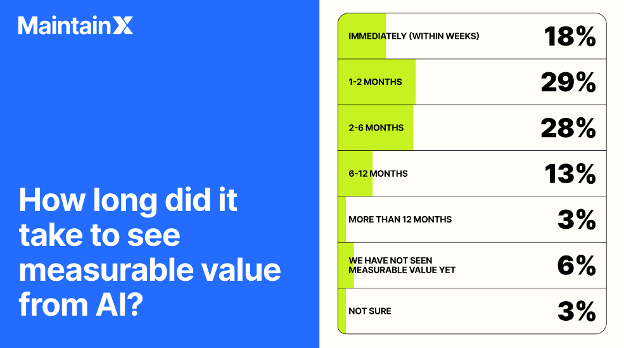
The most common high-value uses are maintenance data analytics, knowledge capture, root cause analysis, work-order scheduling, and real-time repair assistance. Three-quarters of teams using AI see measurable returns within six months.
Pair technology investments with workforce investments. That means improving training, capturing the knowledge of experienced technicians before they retire, and using AI and CMMS/EAM platforms to make that expertise accessible to less-experienced staff at the point of work.
No. 45% of leaders plan to grow headcount this year, but they also recognize that hiring alone won’t fix the gap. The faster path is making the workforce they already have more productive through better tools, clearer procedures, and stronger knowledge transfer to the new people starting every day.
The plants that turn the corner first will be the ones that pair their AI investments with the work of building a stronger maintenance culture, one trained technician and one captured procedure at a time.

About the Author:
Chris Turlica is CEO and co-founder at MaintainX, an AI-powered maintenance and asset management platform built for the people who keep the physical world running. Chris is a tech entrepreneur with experience in buy-side finance and SaaS innovation.
Read more from the author:
The AI Layoff Debate Is Missing What Matters Most | IEN, April 20, 2026
The Maintenance Stack Is Your Company’s MVP: Treat It Like Enterprise Intelligence | Forbes, February, 20, 2026

Forging the Next 250 Years: Powering the Next Era of American Manufacturing
As manufacturers offer more customization than ever before, managing product complexity has become a critical challenge. Tune in with Dan Joe Barry, Vice President of Product Marketing at Configit, who explores how companies are tackling the growing number of product configurations across engineering, sales, manufacturing, and service. He explains how Configuration Lifecycle Management (CLM) helps organizations maintain a single source of truth for configuration data. The result: fewer errors, faster quoting, and the ability to deliver customized products at scale.
Get In Touch
Google news and SEO compliant, Industry Today’s state-of-the-art digital media platform offers bespoke media campaigns that target key decision makers and buyers to achieve your marketing and promotional goals.

Contribute
Showcase your brand and promote your business to our highly targeted audience. We offer detailed Google Analytics with measurable ROI to assure success. Submit your content for review by our Editorial team who will contact you to discuss the project further.
About Us
Reach Your Targeted Audience and Grow Your Business. Learn more About Industry Today.
Contact Us

© 2026 Industry today. All Rights reserved.