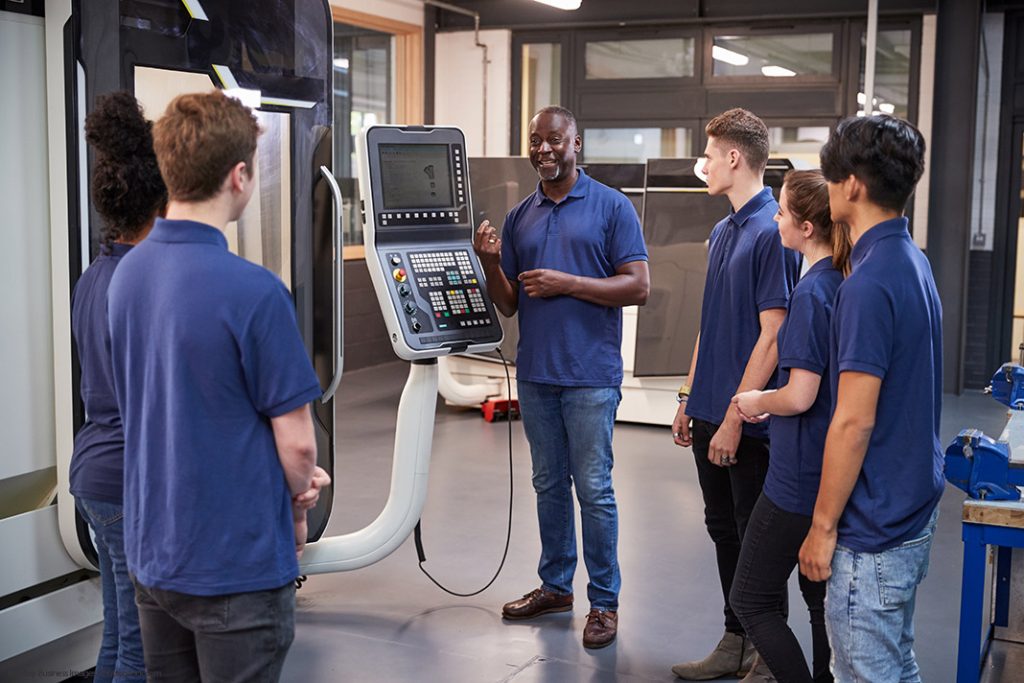
From startup checks to interrupted breaks, manufacturers must account for required work that happens beyond scheduled shifts and paid hours.
A production schedule rarely tells the whole story. Work that has to happen before clock-in, in the middle of an interrupted break, or after a shift officially ends can go missing from it. Wage and hour attorneys look for those gaps and try to figure out which required minutes went unpaid.
Minutes, not whole shifts, are where most manufacturing pay disputes begin. Ten minutes of startup checks cut from every shift on one line adds up fast once you multiply it across a crew and a year. The U.S. Department of Labor’s Wage and Hour Division recovered roughly $127 million in overtime back wages for 101,043 workers in fiscal year 2024. Setting the enforcement numbers aside, the question for your plant comes down to something simpler: does the timekeeping system capture the work employees actually do, including the tasks a supervisor expects them to finish after the scheduled hours end?
The Department of Labor’s hours-worked guidance explains that hours worked generally cover any work you require or allow, even work you merely have reason to know about. Federal law sets rules on minimum wage, overtime pay, and recordkeeping.
Pre-shift duties, post-shift duties, and interrupted breaks all run into those requirements, and state law can pile on top of them. Once those minutes spark a dispute, the two frameworks get applied together against your payroll records for the state where the work happened, and that combined analysis is really the heart of what wage and hour attorneys do in these cases.
A schedule or a clock punch is not proof of what work actually happened. Each record exists for its own purpose. Your payroll may show a completed shift even while a maintenance application logs a technician troubleshooting a production alarm at 9:14 p.m.
Federal law sets a baseline, but states can layer stronger protections on top. Short break and meal period rules vary from one state to the next, so look at where the work happens before you apply a single payroll setting to several plants.
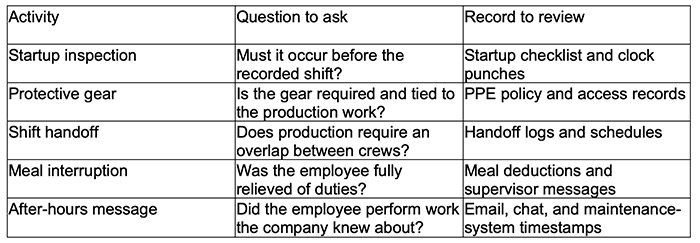
When required startup checks form part of an employee’s productive duties, they generally count as work. A guard inspection or a sanitation verification both fit that description. Just showing up early doesn’t. Compare checklist timestamps with punches, then ask who instructed the employee to complete the check before clock-in, and whether the required inspection begins at the workstation before the time clock even lets the employee record the shift.
PPE requires a closer look. Consider what employees must wear, where they may put it on, and how it relates to their principal work. Review the plant’s changing rules and any collective bargaining terms before deciding how to treat the time. Required production gear raises different questions than a uniform employees may wear during their commute.
Shutdown tasks can be paid work even after the scheduled shift ends. Supervisors shouldn’t direct employees to clock out before required cleaning or machinery shutdown. The Department of Labor’s guidance on compensable work time addresses work performed outside scheduled hours. Compare the final cleaning signoff with the employee’s punch.
Required training generally counts as hours worked under the department’s Hours Worked fact sheet. Exclusion generally requires every condition: attendance occurs outside regular hours, participation is genuinely voluntary, the session isn’t directly related to the job, and no productive work occurs. A required machine-safety refresher belongs in paid time.
An unpaid bona fide meal period requires complete relief from duties. If an operator must monitor the line or answer production calls while eating, an automatic deduction may be subtracting working time. Federal guidance generally treats brief rest periods of roughly five to 20 minutes as paid time. Your timekeeping system should let the operator report an interruption even after the meal period has already been deducted.
Ordinary home-to-work commuting generally isn’t paid under federal rules. Travel between assigned locations during the workday generally is, including a trip between your plant and an off-site warehouse. Dispatch records can establish when that assignment began.
A required handoff may count as work when crews must exchange equipment status or safety information before anyone can leave. Scheduled overlap isn’t proof of actual overlap, though. Compare badge swipes, workstation logins, and production-system timestamps to identify when the outgoing operator actually finished.
Start with what you already have:
Missing approval doesn’t erase work. Under the standard described above, you must count work the company knew about even if overtime wasn’t authorized. You can enforce a scheduling policy without deleting recorded time or refusing pay. Preserve the original entry and any correction, with the supervisor’s explanation attached to the edited-punch report.
The Department of Labor’s record retention rules generally require payroll records to be kept for at least three years and wage-computation records for two. Keep the worksheets used to calculate pay, not only the final payroll totals.
Salary alone doesn’t establish an overtime exemption. Job duties and applicable salary requirements also matter, and manual production work doesn’t become exempt through a job title. Check actual duties against the classification record.
Federal law may permit recovery of unpaid minimum wages or overtime plus an equal amount as liquidated damages in appropriate cases, along with attorney’s fees and costs. Sections 15 and 16 of the FLSA address violations and remedies. State remedies and deadlines can differ, so preserve disputed pay statements.
Employment lawyers handling pay disputes compare the employee’s actual duties and work time with federal and state wage rules. They review payroll and time records, estimate unpaid wages, evaluate deadlines and possible remedies, and advise whether an individual, collective, or class claim may fit the facts.
There is no single hourly rate for a highly experienced lawyer, and cost varies by location, experience, and the matter’s complexity. Wage cases may use hourly, contingency, or other fee arrangements, and successful FLSA claims may allow recovery of reasonable attorney’s fees from the employer. Ask for a written agreement explaining rates, costs, and when payment is due.
Suing an employer may be worth considering when the unpaid amount, available evidence, deadlines, likely recovery, and practical costs support a claim. An attorney can compare potential damages and fee options with the time and risk of litigation, while also considering an agency complaint or pre-suit resolution. No outcome is guaranteed.
No universal federal wage law requires employees to notify HR before seeking counsel. Internal reporting may correct payroll errors, but employees should preserve original records and consider filing deadlines. The FLSA prohibits retaliation for protected complaints. Keep copies of the complaint and any subsequent schedule changes.
Compare required activity with recorded time, then examine recurring gaps instead of assuming the time clock tells the whole story. Check automatic meal deductions against actual duties as well. Give supervisors a clear way to report corrections without rewriting original entries. For your next payroll review, pull one week of gate records, machine timestamps, and payroll entries for the same shift, and document each mismatch.

Forging the Next 250 Years: Powering the Next Era of American Manufacturing
Brooklyn Army Terminal (BAT) began as a World War II-era military supply base. Today it is New York City’s largest publicly owned industrial campus, with 59 waterfront acres, more than 4 million square feet and over 100 businesses. In this episode of Industry Insights, Bridget Chansakul, Vice President of Leasing & Portfolio Management at NYCEDC, explains what space is available and what’s planned for the 250,000+ square feet of new industrial space in Building A. She also covers how the ferry, parking and on-site childcare help tenants hire and keep workers, along with workforce partnerships, City incentives for manufacturers and where BAT is headed next.
Get In Touch
Google news and SEO compliant, Industry Today’s state-of-the-art digital media platform offers bespoke media campaigns that target key decision makers and buyers to achieve your marketing and promotional goals.

Contribute
Showcase your brand and promote your business to our highly targeted audience. We offer detailed Google Analytics with measurable ROI to assure success. Submit your content for review by our Editorial team who will contact you to discuss the project further.
About Us
Reach Your Targeted Audience and Grow Your Business. Learn more About Industry Today.
Contact Us

© 2026 Industry today. All Rights reserved.